
15-Year Foreign Investor Residency in Kuwait: Eligibility, Requirements & Benefits
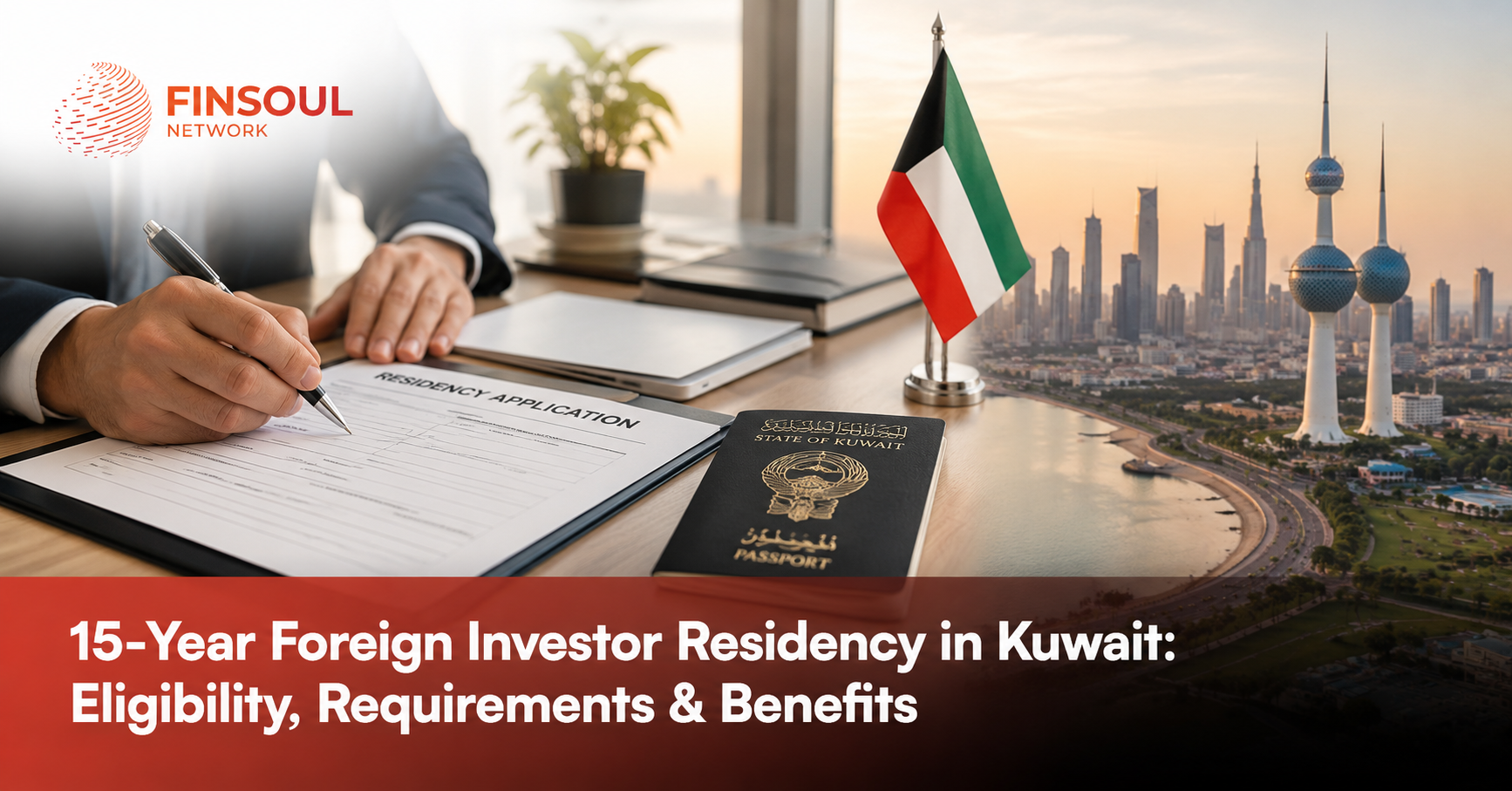
Kuwait City’s gleaming skyline at night symbolizes the country’s growing appeal to international business. Kuwait’s new foreign investor residency in Kuwait program offers long-term visas (up to 15 years) for qualified investors. Under the revised rules (effective December 2025), foreign nationals who establish businesses or invest in Kuwait can obtain extended Kuwait residence permits.
The investment residency in Kuwait concept is designed to attract capital and expertise to Kuwait’s economy. The Kuwait Direct Investment Promotion Authority (KDIPA) oversees this pathway: investors must set up a KDIPA-licensed company under Law No. 116 of 2013 to qualify. The scheme provides unparalleled stability compared to the standard five-year work visa, making it attractive for long-term planning in Kuwait.
Introduction:
Kuwait’s foreign investor residency in Kuwait refers to a dedicated long-term visa category for foreign businesspersons and entrepreneurs. This program grants eligible investors a Kuwait residency visa (or Kuwait residence permit) valid up to 15 years, renewable thereafter. Unlike short-term visas, this investor residency is tied to an approved investment (such as a KDIPA-licensed company) rather than an employer.
The idea is to encourage long-term commitment: by offering a 15-year permit, Kuwait signals stability to foreign investors. In 2026 the KDIPA framework is key: the Direct Investment Promotion Authority vets projects and issues licenses that form the basis of the residency permit. In summary, foreign investor residency in Kuwait gives international investors an extended Kuwait residence permit through qualifying investments, aligning with Kuwait’s vision of economic diversification. For investors looking for structured guidance and setup support, Finsoul Network Kuwait assists in understanding and navigating the process efficiently.
What is Investor Residency in Kuwait?
Investor residency in Kuwait is essentially an investment residency in Kuwait program: a long-term visa for foreigners who invest in Kuwait’s economy. In practice, it works as a Kuwait residency visa route for investors. As one analyst notes, foreign investors licensed under Kuwait’s foreign capital law can now obtain up to 15-year residency. This differs from a standard Kuwait business visa or work visa in several ways:
- A work visa (iqama) or short-term business visa is tied to employment with a Kuwaiti sponsor and typically lasts 1–5 years, often requiring renewal when changing jobs.
- By contrast, the investor residency is tied to the investor’s own business. Once granted, it gives a long-term Kuwait residence permit tied to that investment.
The purpose of this scheme is explicitly economic: to attract foreign capital, technology, and expertise. As Kuwait’s government explained, foreign investors under Law 116 now “may be granted residency for up to 15 years, providing long-term security for investors seeking to establish or expand operations in Kuwait”.
This long-term residency for investors aligns with Kuwait’s effort to diversify beyond oil, encouraging entrepreneurs to start and grow businesses locally.
15-Year Investor Residency Explained
The 15-year investor residency is a special visa category that allows eligible foreign entrepreneurs to reside in Kuwait for up to fifteen years at a time. This route is specifically linked to business investment (unlike the 10-year route for property owners). Under the new regulations, foreigners who establish or acquire a business licensed by KDIPA under the Foreign Capital Investment Law (Law No. 116/2013) qualify for the 15-year residency. In other words, your company or project must be approved by KDIPA as a 100% foreign-owned entity or branch.
Once approved, the 15-year residency is renewable in subsequent 15-year increments, subject to continued compliance. Kuwait’s immigration reforms specify that this residency can be renewed upon application, provided the investor maintains valid health insurance and meets other requirements. In practice, that means you must keep up mandatory local health coverage and continue the business operations for the duration. Importantly, the residency term cannot exceed the insurance coverage period, reflecting Kuwait’s rule that residents must carry health insurance.
Overall, the 15-year investor residency offers exceptional long-term certainty. Instead of renewing a visa every few years, an investor and their family can stay in Kuwait for a decade and a half at a time. This aligns with Kuwait’s goal of retaining high-value foreign investors in key sectors.
Eligibility Criteria for Investor Residency in Kuwait
To qualify for foreign investor residency in Kuwait, applicants must meet several criteria:
- Investment Amount: There is no fixed minimum investment requirement. Each case is evaluated individually, and applications are reviewed holistically. (In practice, significant capital is expected, for example, typical property investments in Kuwait range from KD 200,000–300,000.)
- Approved Business Activity: The investment must be in an approved commercial activity. The business plan should align with Kuwait’s development priorities (diversification, technology transfer, jobs) and not be on the excluded Negative List (certain oil & gas upstream, media/publishing, etc.).
- KDIPA License: The investor’s company or project must be formally licensed by the [Kuwait Direct Investment Promotion Authority (KDIPA)](Kuwait Direct Investment Promotion Authority (KDIPA) )under Law 116. KDIPA evaluates the proposal (business plan, investment amount, jobs, tech transfer, etc.) and issues a decision. Without KDIPA’s green light, the investor residency cannot be granted.
- Clean Record and Health: Applicants must have a valid passport and no criminal history, and they must be in good health. Kuwait’s residency rules explicitly requireforeign residents to have no criminal convictions and to obtain mandatory local health insurance coverage.
- Active Operations: Generally, the business should be active and operating in Kuwait as approved. Merely holding a license without investment capital or operations may jeopardize approval. The project should show ongoing economic benefits (employment, local expenditures, etc.) in line with the original plan.
Meeting all of the above is essential. KDIPA and immigration authorities look for genuine, law-compliant investments. A well-structured business plan, clear funding proof, and adherence to regulations greatly improve the chances of obtaining the residency permit.
Required Documents
When applying for the 15-year investor residency, you will typically need to submit:
- Passport: Copy of the valid passport (with sufficient validity remaining).
- Business License: Official KDIPA-issued investment license or company registration certificate for the project. This shows your company type and ownership structure.
- KDIPA Approval: A copy of KDIPA’s decision/endorsement for the investment (showing approval of the business plan or company formation under the foreign investment law).
- Company Documents: Corporate documents like the Commercial Registration (CR) certificate, Articles of Association, and Memorandum of Association of the Kuwaiti company.
- Financial Proof: Evidence of funding and capital, such as bank statements, capital deposit receipts, or audited financial statements demonstrating you have the required investment funds.
- Other Legal Docs: Additional paperwork may include criminal background checks, health/medical certificates, and completed residency application forms. You will also need passport-size photos and application forms from Kuwait’s immigration portal.
- Family Documents (if sponsoring dependents): Marriage certificate and birth certificates for spouse/children, plus proof you meet the income threshold (min KD 800/month salary or equivalent) for family sponsorship.
It is important to follow the official checklist carefully. Missing or incorrect documents are a common cause of delays. (Kuwait’s authorities have indicated that detailed documentation requirements will be specified in later guidance.)
KDIPA Investor Residency Rules (2026 Update)
Kuwait’s investor residency program operates under the Foreign Capital Investment Law (Law 116 of 2013). This law and its executive regulations issued in 2025 set the framework for foreign investments and the associated residency benefits. Key points of the 2026 rules include:
- 100% Foreign Ownership: Law 116 allows KDIPA to license projects as 100% foreign-owned companies, branches, or representative offices. In practice, this means investors can fully own their approved Kuwaiti business, a major liberalization in Kuwait’s traditionally restrictive market.
- Investment Incentives: Law 116 guarantees incentives to qualified investors. For example, investors are entitled to a tax exemption on corporate income (and other taxes) for up to 10 years from start of operations. They also get customs duty exemptions on imported machinery and raw materials for the project. Importantly, these incentives cannot be less favorable than those granted under previous law. In short, KDIPA-licensed projects receive significant fiscal benefits.
- Residency Tied to Investment: The 2025 executive regulations (Ministerial Resolution No. 2249) explicitly link residency length to the investment route. Foreign investors under Law 116 can obtain up to 15-year visas, whereas other categories (like property owners) qualify for up to 10 years. The standard five-year visa remains for typical workers.
- Mandatory Insurance and Fees: The updated rules impose mandatory health insurance: Kuwait will not issue or renew any residency permit without valid coverage, and the permit term cannot exceed the insurance period. Annual renewal fees for investor residency are set (e.g. KD 50/year) and family dependent fees have increased.
- Ongoing Compliance: Investors must comply with all Kuwait regulations. KDIPA and the Interior Ministry expect the business to meet its commitments (e.g. employment of Kuwaiti nationals) and remain within approved activities. The law also reinforces anti-fraud measures: for instance, visa trading (using the investor visa for unrelated persons) is prohibited.
In summary, the KDIPA 2026 framework makes the investment residency in Kuwait both attractive and strict. It offers major benefits (100% ownership, incentives, long-term visa) but ties them to clear compliance rules and governance.
Benefits of 15-Year Investor Residency
Long-Term Stability: The biggest benefit is stability. A renewable 15-year Kuwait residence permit means investors and their families can live in Kuwait with peace of mind. No more annual visa renewals – you deal with immigration once every decade and a half. This allows long-term planning for business and personal life. As one advisor notes, “longer residency terms offer increased stability and flexibility to pursue personal and professional goals”.
- Family Sponsorship: Holder of this investor residency can sponsor eligible dependents (spouse, children) under Kuwait’s rules. With the permit, your immediate family can join you in Kuwait. (Keep in mind Kuwait’s minimum salary threshold of KD 800/month for sponsoring a spouse or child.) This enables families to settle together.
- Business Growth Flexibility: A stable residency visa makes it easier to expand or restructure your business. You can open bank accounts, apply for loans, or lease property with confidence because you have guaranteed long-term legal status. Investors often find it simpler to hire specialized talent when they have a firm residency backing
- Banking and Financial Access: Having a long-term Kuwait residency visa often eases banking processes. For example, banks are more willing to extend credit, loans or mortgages to someone with a secure long-duration permit. It also facilitates larger financial transactions (e.g. capital repatriation or profit transfers).
- Enhanced Quality of Life: Holding a long-term Kuwait residency means fewer administrative hurdles. You won’t face annual visa bureaucracy, and you can travel in and out of Kuwait freely (subject to visa rules of destination countries) during those 15 years. In essence, the program greatly simplifies life for an investor compared to regular tourist or work visas.
Overall, the 15-year investor residency provides unmatched convenience and confidence. It is essentially a golden ticket for serious investors to call Kuwait home for the long haul.
Application Process Step-by-Step
The application for the 15-year investor residency involves several key steps:
- Establish or Acquire a Kuwaiti Investment Entity: First, set up a business under KDIPA. This typically means applying for a Kuwaiti joint-stock company, LLC, branch, or representative office licensed by KDIPA. For an existing foreign company, one might establish a local branch. Ensure the company’s economic activity is approved and not on the negative list.
- Submit Business Proposal & Obtain KDIPA License: Prepare a detailed business plan and submit it to KDIPA via their online portal. KDIPA will review the plan (technology transfer, job creation, etc.) and either approve or request modifications. Once KDIPA approves, it issues an investment license or certificate. You will need this document for the residency visa application.
- Gather Required Documents: Collect all necessary paperwork (see Required Documents above). This includes passport copies, the KDIPA license, company registration papers, proof of funds, health insurance enrollment, and clean records. If you plan to bring a family, prepare their documents too.
- Apply for Residency Visa: With KDIPA approval in hand, apply to the Kuwaiti Ministry of Interior (MoI). This is usually done via Kuwait’s online e-government portal (e.g., e-government Kuwait). Submit the residency application form and upload the documents. Pay any applicable visa fees.
- Attend Medical and Security Checks: Often, applicants must undergo a health check in Kuwait and obtain a police clearance certificate (from their home country or Kuwait). Submit these results as required.
- Approval & Residency Issuance: If the MoI approves the application, you and any dependents will receive a residency visa approval (often an “iqama” reference). Foreign applicants may then travel to Kuwait (if not already in-country) to finalize the residency stamping. Inside Kuwait, one registers with the Public Authority for Civil Information (PACI) to get an ID card.
Each of these steps should be done meticulously. KDIPA applications typically have a processing timeline (often about 30 working days). The subsequent residency visa step with MoI can take additional weeks. Applicants are advised to plan accordingly and consult with a legal or immigration expert to streamline the process.
Common Mistakes to Avoid
- Investors should be aware of frequent pitfalls in the process: Incomplete Documentation: Forgetting even one document (e.g. a missing page in the business license or an unsigned form) can delay approval. Always double-check the full checklist.
- Wrong Business Classification: Ensure your business activity matches KDIPA’s approved categories. Applying under an incorrect SIC code or disallowed sector will lead to rejection.
- No KDIPA Approval: Do not apply for the residency visa before obtaining the KDIPA investment license. Without KDIPA’s positive decision, the residency request will fail.
- Neglecting Compliance: Failing to meet ongoing requirements (like not renewing health insurance, not maintaining minimum capital, or not hiring required Kuwaiti employees) can endanger your status. Remember that renewals will scrutinize these aspects.
- Overlooking Fees and Conditions: The new system has specific fees (for example, the residency fee for investors is KWD 50/year, and there are annual fees for family members). Plan for these costs. Also note the KD 800 minimum salary rule for sponsoring family; underestimating this can halt family visa applications.
- Visa Trading and Transfers: Kuwait strictly prohibits “visa trading” (selling or misusing your investor visa). Any transfer of sponsorship or changing of investor sponsor must go through official channels. Avoid any side arrangements, as violations can lead to cancellation or fines.
By avoiding these errors and staying organized, applicants can significantly improve their success rate in obtaining the Kuwait investor residency permit.
Conclusion:
Kuwait’s new 15-year investor residency is a landmark program in 2026, providing unprecedented long-term residency rights to foreign investors. By obtaining this visa, entrepreneurs secure a Kuwait residence permit that offers stability for themselves and their families, while unlocking opportunities in Kuwait’s dynamic market. Key benefits include ability to fully own a Kuwaiti company, tax incentives under Law 116, and simplified life through a long-duration visa. For 2026 and beyond, this program is central to Kuwait’s efforts to attract FDI and diversify its economy.
If you meet the investment criteria, consider consulting an expert to navigate the process. A specialized Kuwait business formation service or immigration consultant can guide you through KDIPA licensing and residency applications, helping ensure all requirements (documents, fees, compliance) are met. With professional assistance, you can leverage Kuwait’s 15-year investor residency to establish or expand your business, and enjoy the long-term perks of a stable Kuwait residency. For end-to-end support and expert guidance, Finsoul Network Kuwait can assist you throughout the entire process.
FAQs
Who is eligible for foreign investor residency in Kuwait (2026)?
Any foreign national who establishes or invests in a KDIPA-approved project under Law 116 can apply. The applicant must have a valid passport, clean criminal record, and an approved business activity aligned with Kuwait’s investment regulations.
What are the requirements for foreign investor residency in Kuwait under KDIPA Law 116?
Applicants must secure KDIPA approval, establish a licensed business in Kuwait, provide proof of investment funds, submit legal documents, and maintain compliance with Kuwait’s investment and residency rules.
Can family members be sponsored under foreign investor residency in Kuwait?
Yes, investor residency holders can sponsor their spouse and children. However, Kuwait’s family sponsorship rules apply, including minimum income requirements and valid residency conditions.
How long does approval take for foreign investor residency in Kuwait application?
The full process usually takes around 1 to 3 months. KDIPA approval typically takes about 30 working days, followed by residency issuance from the Ministry of Interior.
Is renewal required after 15 years in foreign investor residency in Kuwait program?
Yes, the 15-year investor residency is renewable. Renewal depends on continued business compliance, valid health insurance, and meeting Kuwait’s residency conditions at the time of renewal.
What is the minimum investment for foreign investor residency in Kuwait?
There is no fixed minimum investment amount. Each application is reviewed individually based on the business plan, sector, and economic impact. However, a substantial investment is generally expected.
Table of Contents
Book An Appointment
No Comments