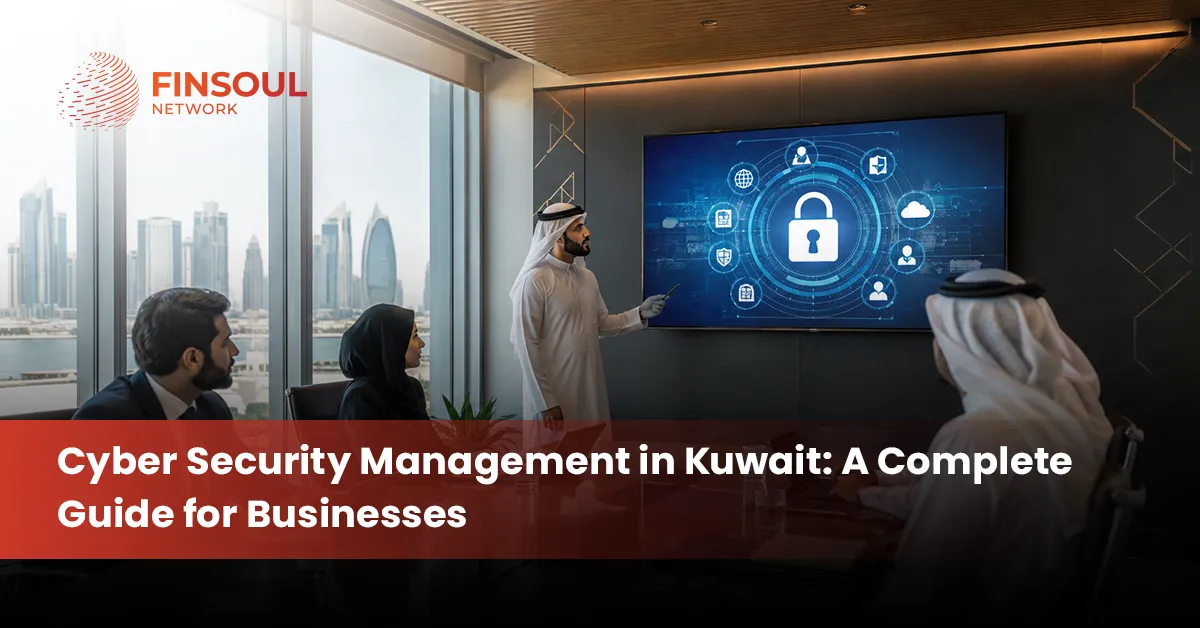

Cyber Security Management in Kuwait: A Complete Guide for Businesses
Cyber security management has become a core business priority for organisations operating in Kuwait. As companies move more services, customer records, financial processes and internal operations online, a single security weakness can affect business continuity, confidential information and customer trust. Finsoul Network Kuwait helps businesses establish structured security practices that address technology, people, processes and regulatory responsibilities.
Modern businesses cannot treat cybersecurity as a one-time IT exercise. Effective protection requires ongoing risk assessment, access controls, monitoring, employee awareness, incident response and regular improvement. This guide explains how businesses in Kuwait can build a practical security management approach and what they should consider when selecting professional support.
What Is Cybersecurity Management?
Cyber security management is the organised process of identifying, assessing and reducing risks to an organisation’s systems, networks, applications and information. It combines governance, technical controls, policies, monitoring, staff awareness and incident response so that security becomes part of normal business operations.
The objective is not simply to prevent every attack, which is unrealistic. The objective is to reduce exposure, detect suspicious activity quickly, limit damage and restore important operations when an incident occurs. A mature programme also assigns responsibility to management and employees instead of leaving cybersecurity entirely to an IT department.
Why is cybersecurity important for Kuwait Businesses?
Businesses in Kuwait increasingly depend on cloud platforms, online payments, enterprise applications, connected devices and remote access. These systems improve efficiency but also create more points that attackers can target. Phishing, credential theft, ransomware, malicious software, insider misuse and third-party vulnerabilities can disrupt operations even when a company has basic antivirus and firewall controls.
Kuwait’s regulatory environment also makes responsible handling of information important. CITRA’s current Data Privacy Protection Regulation was issued under Decision No. 26 of 2024 and replaced the earlier 2021 regulation. The regulation addresses areas including data classification, personal-data collection and processing conditions, consent and transparency. Businesses should assess which obligations apply to their activities rather than assuming that a generic privacy policy is sufficient.
What are the main cybersecurity risks in Kuwait?
Phishing and Social Engineering
Phishing attacks remain a major business risk because attackers often target employees rather than technical infrastructure. A convincing email, message or phone call can expose credentials, redirect payments or introduce malicious software. Businesses should train employees to verify unusual requests, avoid suspicious links and report potential attacks quickly.
Ransomware and Malware
Ransomware can make important systems and files inaccessible, potentially stopping normal business operations. Malware can also steal information, monitor activity or provide attackers with unauthorised access. Regular patching, endpoint protection, network controls and secure backups can reduce exposure and improve recovery capabilities.
Weak Access Controls
Weak passwords, excessive privileges and poor account management can allow unauthorised users to reach sensitive systems. Former employees and inactive accounts can also create unnecessary security gaps. Businesses should apply least-privilege access and review user permissions regularly.
Cloud and Third-Party Risks
Companies increasingly rely on cloud platforms, software providers, payment processors, hosting companies and external IT providers. A weakness at one supplier can create risks for several connected organisations. Supplier due diligence, contractual security requirements and appropriate access controls should therefore form part of the security programme.
Remote Work and Mobile Security
Remote access can introduce additional risks when employees use unmanaged devices, insecure networks or outdated software. Organisations should establish clear requirements for remote connections, company devices, authentication and data access.
How Does Security Management Work?
A practical programme begins with understanding the organisation’s assets, information and business processes. The business can then identify threats, assess vulnerabilities and prioritise risks according to their potential impact.
Conduct a Cybersecurity Risk Assessment
A risk assessment identifies critical systems, sensitive information, likely threats and existing controls. It should consider financial loss, operational disruption, regulatory exposure, reputational damage and potential effects on customers.
Establish Security Policies and Governance
Policies should define acceptable use, password standards, access rights, data handling, remote working, incident reporting and individual responsibilities. Senior management should approve the framework and review it periodically.
Strengthen Identity and Access Management
Access should follow the principle of least privilege. Multi-factor authentication, strong authentication methods, role-based access and timely removal of unnecessary accounts can significantly reduce the risk of account compromise.
Protect Networks and Endpoints
Firewalls, endpoint protection, secure configurations, patch management and network segmentation can reduce exposure and make it more difficult for attackers to move through an environment.
Protect Business Data
Businesses should identify sensitive information and apply appropriate controls for storage, transmission, access and disposal. Encryption can reduce the impact of unauthorised access when properly implemented.
Monitor Security Events
Security monitoring can help organisations identify unusual logins, suspicious network activity and other indicators of compromise. Important logs should be retained appropriately and reviewed according to business risk.
Prepare for Incidents and Recovery
A documented incident response plan should establish who makes decisions, who investigates technical issues, how evidence is handled, how stakeholders are informed and how systems are restored.
What Cybersecurity Regulations Apply in Kuwait?
CITRA plays an important role in Kuwait’s communications and information technology regulatory framework. Its cybersecurity function supports national cybersecurity responsibilities and provides security alerts, awareness resources, security policies and services for both public and private sector audiences.
CITRA’s 2024 Data Privacy Protection Regulation is particularly relevant where businesses fall within its scope. It addresses personal-data collection and processing conditions, transparency, consent and security expectations. CITRA also advises website operators to maintain clear privacy policies and process sensitive user information securely.
The current framework should be considered alongside sector-specific requirements, contractual obligations and other applicable Kuwaiti laws. Businesses should therefore assess their specific industry, data flows, technology environment and regulatory relationships before determining their compliance requirements.
What Should a Kuwait Business Cybersecurity Policy Include?
A strong cybersecurity policy should explain how information is classified, who can access it, how devices are secured and what employees should do when they detect a suspicious event.
Data Classification and Handling
Businesses should define categories for confidential, sensitive, internal and public information. Each category should have clear requirements for storage, access, transmission and disposal.
Password and Authentication Controls
Policies should require strong passwords, multi-factor authentication where appropriate and secure management of privileged credentials.
Employee Access and Device Security
Access should be based on job requirements. Company devices should receive security updates and use appropriate endpoint protection, screen-lock controls and encryption.
Backup and Disaster Recovery
Critical data should be backed up according to a defined schedule. Backups should be protected against unauthorized access and tested regularly to confirm that important information can actually be restored.
Incident Reporting Procedures
Employees should have a simple and clearly communicated method for reporting suspicious emails, lost devices, unusual system behaviour or suspected data exposure.
Vendor and Third-Party Security
Supplier agreements should address security responsibilities, access requirements, incident notification, confidentiality and data handling.
How Can Businesses Conduct a Cybersecurity Risk Assessment?
The first step is to create an inventory of important systems, applications, devices, data and suppliers. Businesses should identify which assets support critical operations and which information would cause serious harm if compromised. The next step involves assessing relevant threats and vulnerabilities. These may include phishing, weak credentials, unpatched systems, insecure configurations, exposed services and supplier dependencies.
Businesses should then evaluate the potential impact of each risk. A compromised payroll system, customer database or production platform may have very different consequences from a non-critical application. Finally, risks should be prioritised. Management can determine which risks require immediate remediation, which require monitoring and which can be accepted with documented approval.
Which Cybersecurity Controls Should Kuwait Businesses Implement?
Businesses should select controls according to their risk profile rather than purchasing technology without a defined purpose. Common measures include multi-factor authentication, endpoint protection, firewalls, secure cloud configurations, vulnerability management, penetration testing, encryption, backup protection and employee security awareness.
Finsoul Network Kuwait can help organisations review existing controls and determine where improvements are needed. The focus should remain on practical risk reduction, measurable outcomes and controls that employees can consistently follow.
Security controls should also be tested. A tool that has been installed but poorly configured or never monitored may provide less protection than expected. Regular testing helps management determine whether controls work as intended.
What Role Does Employee Training Play in Cybersecurity?
Technology cannot fully protect a business from human error. Employees interact with emails, websites, customers, suppliers and business systems every day, making awareness an essential security control.
Training should cover phishing, password protection, suspicious links, social engineering, safe use of cloud services, device security and incident reporting. Periodic awareness exercises can help employees recognise threats before a real incident occurs.
How Should Businesses Respond to a Cybersecurity Incident?
The first priority is to contain the incident without unnecessarily destroying useful evidence. The response team should identify affected systems, isolate compromised devices where appropriate and protect critical operations. The organisation should then investigate what happened, determine the scope of the incident and assess whether data or credentials were exposed. Communication should follow the company’s incident response plan and applicable legal or contractual requirements.
Recovery should include restoring systems from trusted sources, changing compromised credentials, closing the exploited weakness and monitoring for further suspicious activity. After recovery, management should conduct a lessons-learned review. The findings can then be used to strengthen policies, technical controls, training and response procedures.
How Can Businesses Measure Cybersecurity Performance?
Security performance should be measured using practical indicators rather than the number of security tools purchased. Useful measures can include:
- Time taken to apply critical security patches
- Percentage of important accounts protected by multi-factor authentication
- Number of unresolved critical vulnerabilities
- Employee security training completion
- Results from phishing awareness exercises
- Backup restoration success rates
- Average incident detection and response times
- Number and severity of security incidents
Regular assessments and security audits can provide management with an independent view of control effectiveness. CITRA describes a security audit as a systematic analysis of security components, including people, policies, solutions and tools, with attention to compliance and risk.
Which Kuwait Businesses Need Cybersecurity Management?
Cybersecurity applies across sectors, although the nature and level of risk differ.
Financial and Banking Businesses
Financial organisations handle valuable financial information and transactions, making identity protection, access controls, monitoring and incident response particularly important.
Healthcare Organisations
Healthcare businesses manage sensitive patient and operational information. Strong access controls, secure systems and appropriate data protection measures are essential.
Retail and E-Commerce Companies
Retailers and online businesses may process customer details, payment information and transaction records. Security weaknesses can affect both revenue and customer confidence.
Oil, Gas and Industrial Businesses
Industrial organisations may operate connected systems and operational technology environments. Security planning should account for both information systems and operational continuity.
Technology and Telecommunications Companies
Technology businesses may manage large volumes of customer information and interconnected systems. Strong security governance becomes particularly important as services scale.
Professional and Corporate Services
Accounting, consulting, legal, real estate and other professional businesses often hold confidential client and financial information that requires appropriate protection.
The right approach depends on the organisation’s systems, data, suppliers, workforce and risk profile rather than simply its industry classification.
What are the Benefits of Professional cybersecurity Management?
Professional support can help businesses identify weaknesses that internal teams may overlook and establish a structured programme around business priorities. It can also help management understand which risks require investment and which controls should receive attention first. A structured programme can improve security visibility, strengthen access controls, support regulatory responsibilities, reduce the potential impact of incidents and improve business continuity.
Finsoul Network Kuwait supports businesses with practical security planning, risk assessment, policy development, control reviews and ongoing advisory support. The objective is to connect security requirements with operational needs without creating unnecessary complexity.
How Much Does Cybersecurity Management Cost in Kuwait?
There is no single standard fee because cybersecurity requirements vary considerably between organisations. A small company with limited systems may require an initial assessment and foundational controls, while a larger organisation may need continuous monitoring, testing, policy management and incident-response support. Factors that can affect cost include:
- Number of employees and users
- Number of offices or operating locations
- IT infrastructure complexity
- Cloud adoption
- Data sensitivity
- Regulatory requirements
- Security testing requirements
- Number of applications and devices
- One-time assessment versus ongoing support
Finsoul Network Kuwait can assess the organisation’s requirements before recommending an appropriate scope of work.
How Can Businesses Choose a Cybersecurity Management Provider in Kuwait?
Businesses should look beyond a provider’s technology catalogue. They should ask how the provider assesses risk, documents findings, prioritises remediation and measures improvement. A capable cyber security consultant should understand both technical controls and business requirements. Organisations comparing cyber security companies should review relevant experience, methodologies, reporting quality, service scope and incident-response capability.
Businesses considering cyber security consulting companies should also confirm how the provider handles confidentiality, access to systems, third-party tools, reporting and ongoing support. The objective should be a measurable security programme rather than simply a collection of security products.
Cybersecurity Checklist for Kuwait Businesses
Businesses can use this checklist as a practical starting point:
- Maintain an up-to-date inventory of systems, devices and critical data.
- Conduct regular cybersecurity risk assessments.
- Apply multi-factor authentication to important accounts.
- Remove unnecessary access and inactive accounts.
- Patch operating systems, applications and network devices.
- Protect endpoints and monitor important systems.
- Maintain secure and tested backups.
- Train employees to identify phishing and social engineering.
- Review suppliers and third-party access.
- Maintain an incident response and recovery plan.
- Review privacy and security obligations applicable to the business.
- Test and improve security controls regularly.
- Review Kuwait cyber security requirements relevant to the organisation’s sector and activities.
- Evaluate whether existing cyber security solutions address actual business risks.
Conclusion: Strengthen Your Business Cybersecurity in Kuwait
Cybersecurity should be managed as an ongoing business responsibility rather than a one-time technology project. Businesses that understand their risks, protect important systems, train employees, monitor security events and prepare for incidents can reduce exposure and respond more effectively when threats occur.
For organisations that need professional guidance, Finsoul Network Kuwait can help assess current security practices, identify gaps and develop a practical improvement plan. A structured approach can strengthen resilience while supporting responsible handling of business and personal information.
Frequently Asked Questions
Is Cybersecurity Mandatory for Businesses in Kuwait?
There is no single cybersecurity requirement that applies identically to every business. Obligations can vary according to sector, activity, data processing and regulatory relationships. Businesses should assess the requirements that apply specifically to their operations.
What Does a Cybersecurity Risk Assessment Include?
A risk assessment normally covers assets, data, threats, vulnerabilities, existing controls, potential business impact and risk priorities. A useful assessment should finish with practical actions for reducing significant risks.
How Often Should Businesses Conduct Security Assessments?
The appropriate frequency depends on business risk and changes to systems, suppliers and operations. Assessments should also be revisited after major technology changes, significant security incidents or material changes in regulatory requirements.
Does Kuwait Have Data Privacy Requirements?
Yes. CITRA issued its current Data Privacy Protection Regulation under Decision No. 26 of 2024. It replaced the previous 2021 regulation and addresses areas including personal-data collection and processing.
Why Should Businesses Outsource Cybersecurity Management?
Outsourcing can provide access to specialist knowledge, structured assessments and ongoing support without requiring a large internal security team. It can be particularly useful for organisations that do not have dedicated cybersecurity expertise.
Table of Contents
Book An Appointment
No Comments