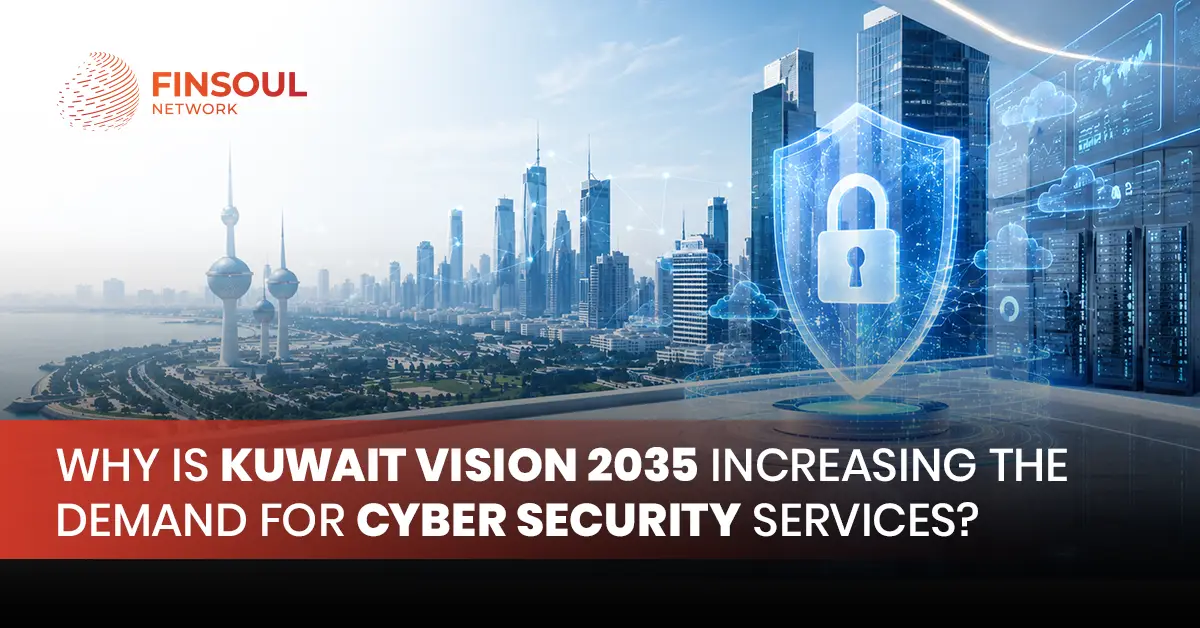

Why is Kuwait Vision 2035 increasing the demand for Cybersecurity Services?
Kuwait is going digital fast. Under New Kuwait Vision 2035, the government is pushing businesses, financial institutions, and public sector entities toward cloud infrastructure, paperless operations, and AI-driven automation. That shift is real, and it is accelerating.
But every new digital system is a new attack surface. As more Kuwaiti businesses move their operations online, ransomware groups, phishing networks, and state-sponsored hackers are paying attention. The demand for cybersecurity services in Kuwait is not a trend driven by preference, it is driven by necessity. Businesses that ignore this are not just vulnerable; they are non-compliant.
Digital Transformation Under Kuwait Vision 2035:
The goal of Kuwait Vision 2035 is to diversify the economy and build a knowledge-based digital nation.
Key developments include:
- Government services moving to digital platforms
- Banking and financial services becoming fully online
- Businesses adopting cloud infrastructure
- AI tools being integrated into daily operations
Table of Contents
As a result, data creation and digital dependency have increased significantly across all sectors in Kuwait.
Cloud Adoption and AI Risks:
Organizations in Kuwait are rapidly migrating to cloud platforms such as AWS, Microsoft Azure, and local hosting environments.
At the same time, AI-based automation is being used in customer service, finance, HR, and logistics. However, many businesses are adopting these technologies without strong security foundations.
Common risks include:
- Misconfigured cloud storage
- Weak identity and access management
- Unpatched APIs and integrations
- Lack of monitoring and visibility
Even a minor configuration error can expose sensitive business and customer data.
Growth of FinTech and Financial Cyber Risks:
Kuwait’s fintech industry is expanding quickly with:
- Digital banking applications
- Mobile wallets
- Online payment systems
This shift has moved a large volume of sensitive financial data into digital environments, including personal identity information, account details, and transaction records.
Financial data remains one of the most targeted assets by cybercriminals globally, making security essential for fintech and banking organizations.
Strict Regulatory Compliance: CITRA and Central Bank of Kuwait Frameworks
In 2026, compliance in Kuwait is no longer optional. Two regulatory bodies now set the rules, and the penalties for falling short are significant.
CITRA (the Communications and Information Technology Regulatory Authority) governs data privacy, network security standards, and incident reporting for businesses operating in Kuwait. The Central Bank of Kuwait (CBK) has its own cybersecurity framework that applies specifically to financial institutions, fintechs, and payment service providers.
Together, these two bodies define what counts as adequate security compliance for businesses operating in Kuwait.
Meeting CITRA's Data Privacy and Protection Standards:
CITRA requires businesses to implement specific data protection controls, maintain audit trails, and report breaches within defined timeframes. Companies handling customer personal data, which covers most retail, healthcare, and services businesses must have documented security policies and technical controls in place.
The cybersecurity framework required by CITRA is not a checklist you complete once. It requires ongoing monitoring, regular assessments, and updated incident response procedures. We help businesses build and maintain these controls as a direct service, not a referral.
Penalties and Risks of Non-Compliance for Local SMEs:
Small and medium businesses often assume these regulations apply only to large corporations. They do not. CITRA and CBK apply their rules to businesses of all sizes. Fines for non-compliance can reach significant amounts, and a data breach that becomes public can destroy customer trust that took years to build.
For SMEs, a single ransomware incident without proper backup and recovery systems can mean permanent closure.
Is your business fully compliant with the latest CITRA regulations? Don’t risk heavy penalties. [Book a Free 30-Minute Cyber Security Consultation Today]
Eligibility Criteria: Can Your Business Get 100% Ownership?
The threat landscape in Kuwait has changed. A few years ago, most cyber attacks in the Gulf targeted large financial institutions. Today, logistics companies, retail chains, clinics, and law firms are all being hit.
The reason is simple: smaller businesses have valuable data and weaker defenses. That combination makes them attractive targets.
Phishing and Ransomware Attacks on the Rise:
Phishing attacks in Kuwait have increased sharply over the past two years. Employees receive emails that look like they are from a supplier, a bank, or even an internal department. One click installs malware that can lock an entire network within hours.
Ransomware groups specifically target businesses that cannot afford downtime: logistics operators, hospitals, and retail businesses with time-sensitive operations. They know these businesses are more likely to pay than lose days of revenue.
Cyber resilience against these attacks requires more than antivirus software. It requires layered defenses, employee training, and tested recovery systems.
Intellectual Property and Financial Data Theft:
Beyond ransomware, targeted data theft is growing. Kuwaiti businesses in construction, engineering, and professional services hold proprietary project documents, contract details, and client financial data. Competitors, sometimes operating through criminal networks, pay for access to this information.
True cyber resilience means protecting not just your systems but the business intelligence that took years to accumulate.
Key Cybersecurity Services in Kuwait Your Business Needs in 2026:
Finsoul Network Kuwait directly delivers the following cybersecurity services in Kuwait to businesses operating across the country. These are not consultations or referrals; we implement, monitor, and manage these systems for our clients.
Managed Vulnerability Assessment and Penetration Testing (VAPT):
VAPT is the process of testing your systems the way an attacker would. Our team identifies vulnerabilities in your network, applications, and cloud configurations before anyone exploits them. This is one of the most requested cybersecurity services in Kuwait among businesses preparing for CITRA audits. We deliver a detailed report with risk ratings and a prioritized remediation plan.
For businesses required to meet CITRA or CBK standards, regular VAPT is a documented requirement. We conduct these assessments and produce the compliance documentation your auditors need.
Implementation of Zero-Trust Architecture:
The old model of cybersecurity assumed everything inside your network was safe. Zero-trust assumes nothing is. Every user, every device, and every application must verify its identity before accessing any system.
We design and implement zero-trust architecture across your network, including remote access controls, identity verification systems, and micro-segmentation of critical data. This is the architecture standard that regulators and enterprise clients increasingly require.
24/7 Security Operations Center (SOC) Monitoring:
Cyber attacks do not happen during business hours. Finsoul Network Kuwait’s SOC team monitors your network around the clock, detecting anomalies, isolating threats, and responding to incidents in real time. Most businesses cannot afford an in-house security team. Our managed SOC gives you enterprise-level cybersecurity services in Kuwait at a fraction of the cost of building it internally.
Every alert is triaged by a human analyst, not just an automated system. For businesses comparing cybersecurity services in Kuwait, this distinction matters: automated-only SOCs miss context that a trained analyst catches in seconds.
Why Demand for Cybersecurity is Increasing in Kuwait:
The demand for cybersecurity services in Kuwait is rising due to:
- Rapid digital transformation under Vision 2035
- Increased cloud adoption across industries
- Strong regulatory enforcement (CITRA & CBK)
- Rising ransomware and phishing attacks
- Growing exposure of SMEs to cyber risks
Digital growth is directly increasing cybersecurity needs across all sectors.
Conclusion:
Vision 2035 is not slowing down. Kuwait’s growing digital infrastructure will shape how business operates for the next decade, and security is now essential to participate in that future. Cybersecurity services in Kuwait are no longer optional; they are becoming a legal requirement under CITRA and CBK frameworks. These regulations apply to businesses of all sizes, including SMEs.
Demand for cybersecurity services in Kuwait is rising as more organizations move online. At the same time, ransomware and phishing attacks are increasingly targeting SMEs in logistics, retail, and healthcare. Key solutions such as VAPT, Zero-Trust Architecture, and 24/7 SOC monitoring address the most critical security gaps.
Cyber resilience requires continuous monitoring and regular assessments, not one-time fixes. Ignoring these requirements can lead to financial penalties and serious reputational damage. Finsoul Network Kuwait provides end-to-end cybersecurity services to help businesses stay secure in Kuwait’s digital future.
Secure Your Business Infrastructure with Finsoul Network Kuwait:
Kuwait’s vision is digital, and security is mandatory. Let our expert risk evaluators assess your company’s network vulnerabilities before hackers do.
Office Address: [Oula Tower, Omar Ben Al Khattab St, Block 3, Al Mirqab, Kuwait City, Kuwait]
Email: [info@finsoulnetwork.com]
Phone: [+44 7494 154004]
[Contact Finsoul Network Kuwait for a KDIPA Feasibility Consultation]
FAQs
Do CITRA's rules apply to small businesses in Kuwait?
Yes. CITRA’s data protection rules apply to all businesses handling customer data, regardless of size. CBK rules apply to any entity involved in financial transactions.
How often should a business conduct a VAPT assessment?
At minimum, once per year and after any major system change. CITRA compliance documentation typically requires evidence of regular testing.
What is Zero-Trust Architecture and does my business need it?
Zero-trust means no user or device is trusted by default, even inside your network. Any business with remote workers, cloud systems, or multiple office locations should implement it.
What does a 24/7 SOC service actually include?
Continuous network monitoring, real-time threat detection, incident response, and monthly reporting. Finsoul Network Kuwait’s SOC service covers all of these directly.
How do I know if my business meets the current Kuwait cybersecurity regulations?
The fastest way is a compliance gap assessment. Finsoul Network Kuwait conducts these as a standalone service and delivers a clear report against CITRA and CBK requirements.
No Comments