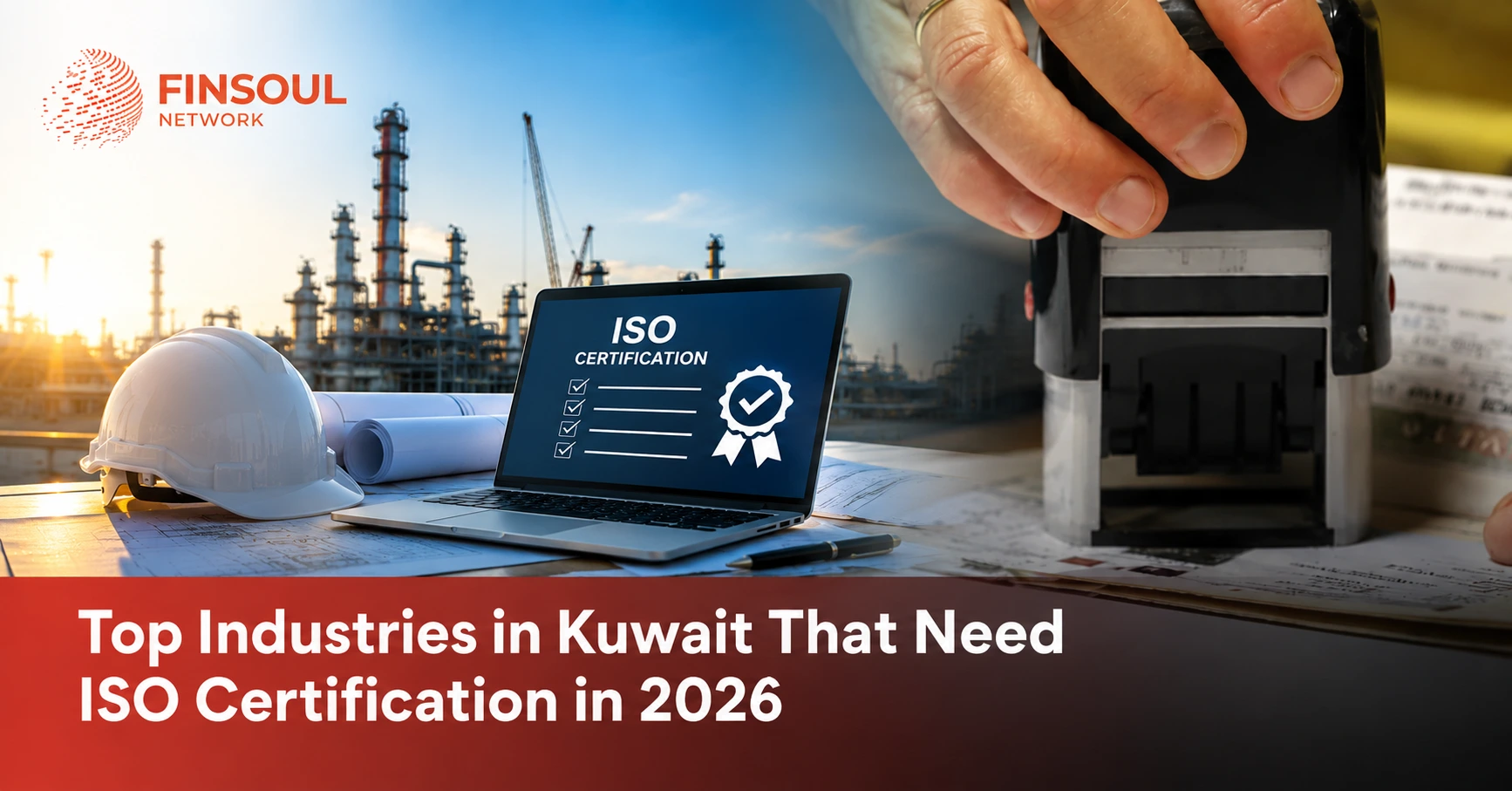
Top Industries in Kuwait That Need ISO Certification in 2026
Businesses across Kuwait are under growing pressure to prove their quality, safety, and operational standards to clients, regulators, and international partners. ISO certification gives them a structured way to do exactly that. ISO Certification in Kuwait is no longer a box to tick for large multinationals. In 2026, government tenders, private contracts, and foreign investment deals increasingly require companies to hold a recognised ISO standard before even qualifying to bid.
The Public Authority for Industry, Kuwait Municipality, and major procurement bodies now treat ISO certification as a baseline requirement across many sectors. This blog covers the top industries where ISO certification delivers the most direct value, what standards apply, and why businesses that delay are putting contracts and credibility at risk.
Need ISO Certification for your industry in Kuwait? Speak with Finsoul Network Kuwait for a free consultation.
Manufacturing Industry:
Manufacturing ISO certification is one of the most in-demand standards in Kuwait’s industrial sector. ISO 9001 gives manufacturers a documented framework for controlling production processes, reducing defects, and meeting customer specifications consistently. Companies that supply government entities or large private contractors are regularly asked to demonstrate ISO 9001 compliance before contracts are awarded.
ISO 14001 and ISO 45001 are also widely adopted by Kuwait manufacturers, especially those handling hazardous materials or operating near residential areas.
Construction and Engineering Sector:
ISO for construction companies is one of the fastest-growing certification needs in Kuwait in 2026. The government’s infrastructure programme, covering roads, bridges, and public buildings, consistently demands that contractors hold ISO certifications as part of prequalification. Without ISO 9001, many firms find themselves disqualified before assessors even review their technical proposals.
ISO 45001 is equally critical on Kuwait construction sites where worker safety risks are high. ISO 14001 covers companies working under Kuwait Environmental Public Authority (KEPA) oversight.
Oil, Gas, and Energy Industry:
ISO for oil and gas operations in Kuwait sits at the intersection of safety, environmental responsibility, and quality assurance.
Table of Contents
Kuwait Oil Company (KOC) and Kuwait National Petroleum Company (KNPC) contractors are expected to hold ISO 9001 for quality management, ISO 14001 for environmental responsibility, and ISO 45001 for occupational safety as standard requirements for vendor registration.
ISO 29001, the petroleum and petrochemical industry-specific quality standard, is gaining traction among service companies that want to stand out in competitive KOC and KNPC tenders.
Construction and Engineering Sector:
ISO for construction companies is one of the fastest-growing certification needs in Kuwait in 2026. The government’s infrastructure programme, covering roads, bridges, and public buildings, consistently demands that contractors hold ISO certifications as part of prequalification. Without ISO 9001, many firms find themselves disqualified before assessors even review their technical proposals.
ISO 45001 is equally critical on Kuwait construction sites where worker safety risks are high. ISO 14001 covers companies working under Kuwait Environmental Public Authority (KEPA) oversight.
Healthcare and Medical Services:
Kuwait’s healthcare sector is expanding through public investment and private hospital growth. ISO 9001 helps hospitals, clinics, and medical equipment suppliers control service quality processes from patient intake to discharge. ISO 15189 applies to medical laboratories, and compliance strengthens accreditation applications with the Kuwait Ministry of Health.
ISO 13485 covers quality management for medical devices and is relevant for any company in Kuwait that manufactures, distributes, or services medical equipment. Certification opens doors to local procurement contracts and regional export opportunities.
Food and Beverage Industry:
ISO for food companies centres on ISO 9001 for quality management and ISO 22000 for food safety. Together, they give food businesses control over every production stage from raw materials to delivery. Kuwait Municipality conducts regular facility inspections, and companies aligned to ISO 22000 handle these far more confidently.
For food companies exporting to GCC or international markets, ISO 22000 is often a condition of entry. Major regional supermarket chains and distributors require suppliers to demonstrate food safety certification before listing their products.
Logistics and Transportation Sector:
An ISO consultant for logistics companies in Kuwait brings real value in an industry where operational complexity and client expectations are both rising. ISO 9001 helps logistics companies document processes for warehousing, fleet management, and customer communication. In a market where shippers switch providers based on reliability, a certified quality management system is a competitive differentiator.
ISO 28000, the supply chain security management standard, is gaining relevance among freight forwarders and customs clearance agents as cross-border trade through Kuwait grows.
IT and Technology Companies:
Kuwait’s IT sector is growing rapidly as businesses accelerate digital operations. ISO 27001, the Information Security Management System standard, is the most widely sought certification for IT companies, managed service providers, and cloud vendors. Government digitisation projects and financial sector cloud adoption make ISO 27001 increasingly a prerequisite for IT vendors seeking public sector contracts.
ISO 9001 and ISO 20000-1 (IT Service Management) complement ISO 27001 for companies that want to demonstrate quality across both delivery and security.
Banking and Financial Services:
Kuwait’s banking sector operates under close Central Bank of Kuwait oversight. ISO 9001 helps banks, insurance firms, and exchange houses control operational processes and support internal quality audits. ISO 27001 is critical for financial services companies managing growing cyber risks and client data protection obligations.
ISO 22301, the business continuity management standard, is increasingly adopted by Kuwait financial institutions. Regulators and large corporate clients want proof that critical services will continue operating through disruptions.
Hospitality and Tourism Industry:
Kuwait’s hospitality sector uses ISO certification to raise service quality and compete for corporate and government contracts. ISO 9001 helps hotels document service delivery processes from guest check-in to maintenance, while ISO 22000 covers kitchen and catering operations at scale.
For hospitality businesses targeting MICE clients or international tour operators, ISO certification signals operational professionalism that competitors without certification simply cannot match.
Government and Public Sector Organizations:
Government entities in Kuwait are adopting ISO standards as part of Kuwait Vision 2035 and broader public service improvement programmes. ISO 9001 gives ministries and public agencies a structured approach to service delivery and documentation, with measurable improvements in process consistency.
ISO 37001 (Anti-Bribery Management) is gaining attention among public procurement bodies, while ISO 14001 applies to environmental agencies and utilities committed to Kuwait’s national sustainability agenda.
Which ISO Standard Is Best for Your Industry?
| Industry | Recommended ISO Standards |
|---|---|
| Manufacturing | ISO 9001, ISO 14001, ISO 45001 |
| Construction & Engineering | ISO 9001, ISO 45001, ISO 14001 |
| Oil & Gas | ISO 9001, ISO 14001, ISO 45001, ISO 29001 |
| Healthcare | ISO 9001, ISO 15189, ISO 13485 |
| Food & Beverage | ISO 22000, ISO 9001 |
| Logistics & Transportation | ISO 9001, ISO 28000 |
| IT & Technology | ISO 27001, ISO 20000-1, ISO 9001 |
| Banking & Financial Services | ISO 27001, ISO 22301, ISO 9001 |
| Hospitality & Tourism | ISO 9001, ISO 22000 |
| Government Organizations | ISO 9001, ISO 37001, ISO 14001 |
Not sure which ISO standard fits your business? Finsoul Network Kuwait helps organizations identify the right certification requirements based on industry regulations, client expectations, and tender eligibility criteria.
Cost of ISO Certification in Kuwait by Industry (2026):
The cost of ISO certification in Kuwait depends on factors such as company size, business complexity, number of employees, and certification scope. Industries with stricter compliance and regulatory requirements generally face higher certification costs.
| Industry | Cost Level |
|---|---|
| Manufacturing | Medium |
| Construction & Engineering | Medium to High |
| Oil & Gas | High |
| Healthcare | High |
| Food & Beverage | Medium |
| Logistics & Transportation | Medium |
| IT & Technology | Medium |
| Banking & Financial Services | High |
| Hospitality & Tourism | Medium |
| Government Organizations | Project-Based |
The exact cost varies from one organization to another. A professional ISO assessment helps determine the most suitable certification scope and investment required for your business.
Benefits of ISO Certification for Kuwaiti Businesses:
Businesses that complete ISO certification consistently report benefits across five areas:
- Access to contracts: Government tenders and international partnerships frequently require ISO certification as a qualification condition
- Operational efficiency: The documentation process identifies waste, duplication, and control gaps that cost money when left unaddressed
- Customer confidence: An ISO certificate tells new clients that an independent auditor has verified your processes against an international standard
- Staff accountability: Clear procedures, measurable targets, and defined responsibilities reduce confusion and improve consistency
- Regulatory readiness: ISO-aligned systems make government inspections and compliance reviews far easier to manage
How Businesses in Kuwait Can Get ISO Certified in 2026:
Getting ISO certified in Kuwait follows a clear process. Whether you are pursuing ISO for construction companies, oil and gas, food, or any other sector standard, the steps below apply:
- Choose the right standard. Your industry, client requirements, and business risks determine which standard fits. A qualified consultant identifies the best option for your situation.
- Gap analysis. A consultant reviews your current processes against the ISO standard and identifies what needs to be developed or improved.
- Documentation and implementation. Your team builds the required procedures, policies, and records. This is the most time-intensive stage.
- Internal audit. Your team checks that the system works as documented and fixes any gaps before the external audit.
- Certification audit. A UKAS-accredited certification body conducts a two-stage audit covering your documentation and live operations. Pass both stages and you receive your certificate.
- Surveillance audits. Annual surveillance audits keep your certification current and valid.
Finsoul Network Kuwait guides businesses through every stage of this process, from standard selection and gap analysis to certification audit preparation and ongoing surveillance support.
Conclusion:
ISO certification is not a luxury for Kuwait businesses in 2026. Across manufacturing, construction, oil and gas, healthcare, food production, logistics, IT, financial services, hospitality, and the public sector, certification is the difference between qualifying for a contract and being turned away at the prequalification stage.
ISO for construction companies remains the single highest-demand certification category in Kuwait right now, driven by the volume of government infrastructure spending. But every sector in this blog faces the same pressure: prove your standards or lose the business.
Finsoul Network Kuwait helps businesses across all these industries get certified, build systems that improve operations, and maintain certification through annual audits. If your business is not yet ISO certified, contact Finsoul Network Kuwait today to book your free consultation and take the first step toward winning more contracts in 2026.
Take the Next Step Toward ISO Certification in Kuwait:
ISO certification helps your business win contracts, improve operations, and build trust across industries in Kuwait. Finsoul Network Kuwait guides you in selecting the right ISO standards and completing certification with ease. Book Your ISO Consultation Today and get started in 2026.
Office Address: [Oula Tower, Omar Ben Al Khattab St, Block 3, Al Mirqab, Kuwait City, Kuwait]
Email: [info@finsoulnetwork.com]
Phone: [+44 7494 154004]
FAQs
What is ISO certification in Kuwait?
ISO certification is an official recognition that a business follows international standards for quality, safety, security, or efficiency in its operations.
Which industries in Kuwait need ISO certification the most?
Key industries include construction, manufacturing, oil and gas, healthcare, food, logistics, IT, banking, and government sectors.
Is ISO certification mandatory in Kuwait?
It is not mandatory for all businesses, but many government tenders, regulators, and large clients require it for eligibility.
How long does ISO certification take in Kuwait?
The process usually takes a few weeks to a few months, depending on company size, readiness, and the chosen ISO standard.
What are the benefits of ISO certification for businesses in Kuwait?
It improves compliance, increases contract opportunities, enhances operational efficiency, and builds stronger trust with clients and regulators.
Do Kuwait government tenders require ISO certification?
Many government tenders and prequalification processes require ISO certification as evidence of quality, safety, or environmental compliance.
Can small businesses get ISO certification in Kuwait?
Yes, SMEs can obtain ISO certification and often use it to improve credibility and compete for larger contracts.
No Comments
Recent Blogs