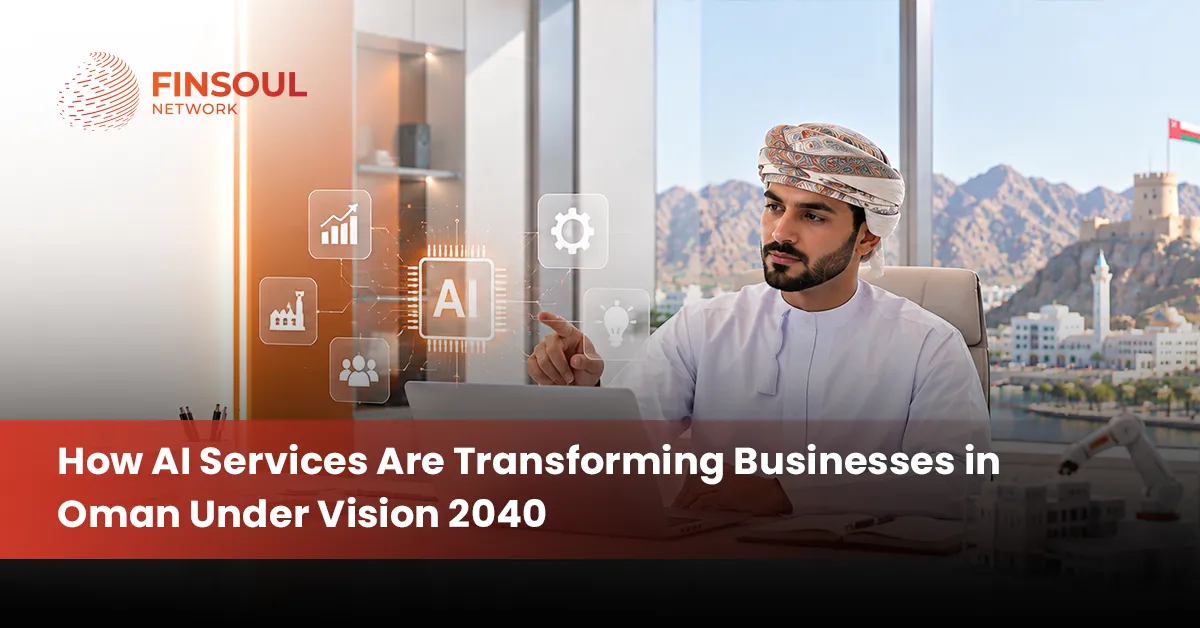

How AI Services Are Transforming Businesses in Oman Under Vision 2040
Artificial intelligence has moved from a buzzword to a real operational tool for companies across the Sultanate. Business owners are no longer asking if AI is worth exploring, they are asking how quickly it can be applied inside their own operations. This shift is closely tied to Oman Vision 2040 and the country’s push toward a digital, knowledge-based economy. Firms like Finsoul Network Oman are watching this shift closely because it changes how companies plan and compete through artificial intelligence services in Oman.
Oman is moving past simple digitisation. The real value now comes from prediction, automation, and smarter decisions, powered by AI systems that learn from company data. A recent PwC survey of Omani CEOs found that 87 percent had adopted generative AI in some form during the previous year, and 56 percent reported increased profitability as a direct result.
Why AI Matters to Oman Vision 2040
This section connects national policy to everyday business decisions. Understanding this link helps company leaders see AI as part of a bigger economic story, not an isolated tech trend.
The National Digital Economy Programme aims to raise the digital economy’s contribution to GDP from 2 percent in 2021 to 10 percent by 2040. AI is one of the primary tools expected to close that gap, since it lets businesses build new digital products rather than simply automating old paper processes. This target signals where government support and funding are likely to flow over the coming years. Firms that align their AI strategy with this national direction position themselves closer to future partnerships and investment.
What AI Services Can Businesses in Oman Use Today?
Many business owners assume AI is complicated or only for large corporations, but the tools available today are practical and accessible. The list below covers what companies of various sizes are already using. Businesses looking for practical AI services in Oman can explore solutions based on their operational needs, data, and existing technology.
- AI-powered automation: Repetitive work such as data entry, invoice processing, and approvals can be handled automatically. This reduces time spent on low-value tasks and lowers manual mistakes.
- AI chatbots and virtual assistants: Website and WhatsApp chatbots can answer customer questions around the clock. Arabic language assistants are becoming increasingly common for local customers.
- Predictive analytics and forecasting: AI can identify patterns in sales, demand, and customer behaviour that humans often miss, letting managers plan with more confidence.
- Intelligent document processing: Contracts, purchase orders, and reports can be scanned and understood automatically, so staff no longer search through paperwork for key details.
- Generative AI for business teams: Marketing content, reports, and proposal drafts can be produced faster with AI assistance, used as a starting point and refined by staff.
- Computer vision and monitoring: Cameras paired with AI can detect quality issues on a production line or flag security concerns.
How AI Is Changing Business Operations in Oman
This is where the real shift happens inside a company. AI does not simply add a new tool, it changes how work gets done day to day.
AI Is Reducing Repetitive Manual Work
Traditional automation follows fixed rules and breaks when conditions change. AI powered automation adapts to new patterns and handles exceptions without constant reprogramming.
This frees staff for judgment calls that need a human. Over time, this reduces backlog and speeds up daily operations.
AI Is Helping Managers Make Faster Decisions
Historical reporting tells managers what already happened. Predictive insight tells them what is likely to happen next.
Instead of waiting for month end reports, managers can view live dashboards that flag problems early. This shift from reactive to proactive management is one of the clearest advantages AI brings today.
AI Is Improving Efficiency and Customer Experience
Customers now expect fast, accurate responses. AI systems can deliver replies in seconds while supporting both Arabic and English speakers without added staffing cost.
Operational gains show up in reduced processing time, fewer errors, and better resource allocation. Faster reporting means leadership can react to market changes within days rather than weeks.
AI Is Creating New Revenue Opportunities
AI is not only about cutting costs. Businesses can use it to build new digital products and data driven platforms that did not exist before.
Companies working with partners such as Finsoul Network Oman often discover that AI opens entirely new service lines rather than simply trimming budgets. This changes how leadership views AI, from a cost item to a growth investment.
Which Omani Industries Can Benefit Most From AI?
The national AI programme identifies healthcare, education, tourism, transport, logistics, oil and gas, manufacturing, fisheries, mining, and renewable energy as priority sectors. Each has its own practical use cases.
- Oil and gas: Predictive maintenance and equipment monitoring reduce unplanned downtime. Safety monitoring also flags hazardous conditions before incidents occur.
- Manufacturing: Quality inspection and defect detection catch problems earlier in the production line. Planning tools help balance output against actual demand.
- Logistics and transport: Route optimisation and fleet management cut fuel costs and delivery times. Warehouse automation speeds up order fulfilment.
- Banking and financial services: Fraud detection and risk analysis protect institutions and customers alike. Credit assessment tools help lenders decide faster.
- Healthcare: Administrative automation frees up clinical staff time. Applications here must always operate within appropriate professional controls.
- Tourism and hospitality: Personalised recommendations and demand forecasting help properties manage pricing and staffing.
- Retail and e-commerce: Product recommendations and segmentation increase conversion rates. Sales prediction supports smarter stock planning.
- Fisheries, mining, and renewable energy: These sectors hold real, often overlooked opportunity, from catch forecasting to equipment monitoring.
What Is Driving AI Adoption Among Omani Businesses?
Several forces are pushing AI adoption forward at the same time, and understanding them helps businesses see why the timing matters now.
Government Support and Growing Investment
The National Programme is backed by active public private collaboration, giving businesses a clearer path toward adoption. MTCIT reported approximately OMR 65 million in AI investment during 2025 as part of investment attracted to communications and IT.
This level of investment signals confidence from both government and private stakeholders. It also means more local expertise and funding is becoming available to businesses of all sizes.
Rising Demand for Arabic and Locally Relevant AI
Generic global AI tools often fail to understand local dialects and customer expectations, which has created strong demand for Arabic-first, Oman-specific solutions. Providers positioning around local requirements are seeing this demand firsthand. Business owners increasingly want systems that reflect how they actually operate, not generic templates built for another market, and this is exactly the gap local firms such as Finsoul Network Oman aim to fill.
Business owners increasingly want systems that reflect how they actually operate, not generic templates built for another market, and this is exactly the gap local firms such as Finsoul Network Oman aim to fill.
How Should an Omani Business Start an AI Project?
Starting an AI project does not require a large budget or a technical team from day one. It requires a clear approach and a willingness to test before scaling.
Identify the Business Problem First
Before choosing any AI tool, define the actual problem you are solving. Common starting points include manual data entry, slow customer responses, or large volumes of unstructured documents.
Skipping this step is the most common reason AI projects stall. A clear problem statement keeps the project focused and measurable.
Assess Data and Technology Readiness
AI systems need reasonably clean, accessible data to function well. Review your existing software, cloud infrastructure, cybersecurity, and staff skills before committing to a project.
Companies with strong ERP or CRM systems already in place tend to see faster results, since AI can plug into existing data flows.
Run a Measurable Pilot
Avoid implementing AI across every department at once. Choose one high value use case, run it as a pilot, and measure results before expanding further.
This limits risk and gives leadership real evidence to support a larger rollout. Training employees during the pilot builds confidence before the system scales.
What Business Benefits Can AI Deliver?
Rather than generic claims, businesses should focus on measurable outcomes that can actually be tracked month over month.
- Lower operating costs: Automating repetitive tasks reduces staffing pressure, and savings can be reinvested into growth areas.
- Faster processes: Approvals, reporting, and customer responses move quicker, shortening cycle times across departments.
- Fewer manual errors: AI systems catch inconsistencies humans often miss under time pressure, which matters most in finance tasks.
- Better forecasting: Predictive tools shift decisions from guesswork to data backed planning.
- New revenue streams: AI can support entirely new services, opening growth paths that did not exist before.
What Are the Risks of Using AI in Oman?
Most articles focus only on benefits, but a realistic view of AI adoption includes understanding its risks. Businesses should weigh these carefully before scaling any project.
- Data privacy risks: Sensitive customer and financial data must be handled with strict controls, or a company risks legal and reputational damage.
- Incorrect or misleading outputs: AI can produce confident but wrong answers if not monitored properly. Human review remains essential in customer facing contexts.
- Cybersecurity threats: AI systems introduce new points of vulnerability if not secured correctly. Regular audits and access controls help reduce this exposure.
- Employee resistance and skills gaps: Staff may resist new systems without proper training and communication.
- Weak governance: Relying entirely on external providers without internal oversight creates long term risk for scaling AI safely.
How Oman Is Addressing AI Governance and Ethics
Oman issued its General Policy for the Safe and Ethical Use of Artificial Intelligence Systems in April 2025, establishing a framework for responsible AI adoption. This policy gives businesses a clear reference point for building their own internal AI practices.
Why Responsible AI Matters to Businesses
Following national governance guidance protects both customers and the company, and builds trust with partners and clients who expect responsible data practices.
Businesses that ignore governance early often face costly rework later, once regulations tighten. Building responsible practices from the start avoids this problem entirely.
What AI Governance Should Cover
Strong governance includes data protection, access controls, human oversight, model monitoring, transparency, and regular risk assessment. These elements work together to keep AI systems safe and accountable.
Companies that build human oversight in from the beginning, rather than as an afterthought, avoid the most serious risks tied to automated decision making.
How AI Will Shape Omani Businesses Towards 2040
Looking ahead, businesses will shift from basic automation toward intelligent operations, where systems learn and improve continuously. Historical reporting will give way to predictive decision making as the standard practice.
Locally developed AI solutions are expected to grow, creating new opportunities for Omani startups and small businesses. The IMF’s latest Oman assessment identifies AI as an important productivity opportunity, while noting Oman still needs further progress in digital access and usage. AI skills will increasingly become a core business capability.
How Can Omani Companies Measure AI Success?
Measuring AI success requires clear metrics tracked consistently over time, not just a general sense that things feel faster.
- Time saved: Track how many hours per week are freed up by automation, often the easiest metric to measure early.
- Operating cost reduction: Compare costs before and after implementation to show direct financial impact.
- Revenue and customer satisfaction: Monitor if AI driven improvements lead to higher sales or better feedback scores.
A simple formula for calculating return on investment is:
Conclusion
AI is no longer a distant concept for Omani businesses, it is an active part of daily operations across multiple sectors. From automation and forecasting to customer service and new revenue streams, the impact is already measurable for companies that have started the journey. Aligning these efforts with Vision 2040 gives businesses a clear direction rather than a scattered approach to adoption. Working with an experienced partner such as Finsoul Network Oman can help companies move from interest to implementation with fewer costly mistakes along the way.
Ready to Start Your AI Journey?
Every business in Oman has a different starting point, from basic manual processes to more advanced digital systems already in place. What matters most is choosing one clear problem, testing a solution, and scaling only once results are proven.
If you are ready to explore what AI can do for your operations, our team at Finsoul Network Oman is here to guide the process from planning through implementation. Reach out today to book a consultation.
Email: info@finsoulnetworkoman.com
Frequently Asked Questions
What are AI services in Oman?
AI services are tools that help businesses automate tasks, forecast trends, and improve decisions using data, including chatbots, predictive analytics, and document processing built for local needs.
Which industries in Oman benefit most from AI?
Oil and gas, manufacturing, logistics, banking, healthcare, tourism, and retail see the strongest results, each applying AI differently, from predictive maintenance to customer service automation.
How much do AI services cost in Oman?
Costs vary based on project scope, data volume, and integration requirements. Businesses should focus on the value delivered rather than a single fixed price.
Is AI suitable for small and medium sized businesses in Oman?
Yes, many AI tools are scalable and affordable for smaller companies. Starting with a focused pilot is often the best approach for SMEs with limited budgets.
What are the main risks of AI adoption in Oman?
Key risks include data privacy concerns, incorrect outputs, cybersecurity threats, and weak governance. Businesses manage these through proper planning, training, and oversight.
Table of Contents
Book An Appointment
No Comments
Recent Blogs