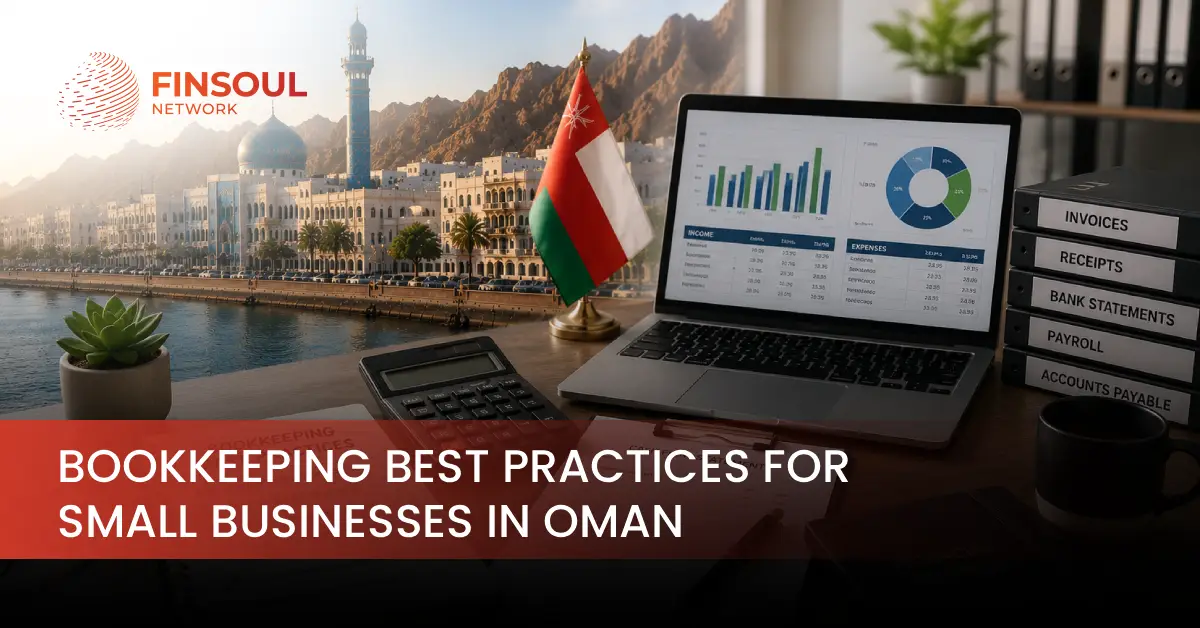

Bookkeeping Best Practices for Small Businesses in Oman
Bookkeeping is the financial operating system of any small business. In Oman’s structured business environment, it directly influences compliance readiness, cash flow stability, and long-term scalability. For most SMEs, bookkeeping is often treated as routine data entry. In practice, it is the foundation that determines whether a business can survive audits, secure financing, and maintain financial clarity under regulatory pressure.
Bookkeeping records daily financial transactions, while accounting interprets those records into insights, reporting, and strategic financial decisions. Many small businesses in Oman operate without clearly separating the two, which leads to reporting gaps and weak financial visibility.
Why Bookkeeping Matters for Small Businesses in Oman
Accurate bookkeeping is not optional for growing businesses; it is a control mechanism that shapes financial discipline.
Financial clarity for decision-making
Proper records allow business owners to track revenue streams, cost leakage, and profit behavior with precision. Without this clarity, decisions become reactive instead of data-driven.
Compliance alignment with Omani requirements
Businesses in Oman are expected to maintain structured financial documentation for regulatory, tax, and audit purposes. Poor bookkeeping increases compliance risk and audit exposure.
Cash flow stability and operational control
Cash flow issues are rarely caused by low revenue alone. In most cases, they result from poor tracking of receivables, payables, and expense timing.
Improved credibility with financial institutions
Banks and investors assess financial discipline before extending credit or capital. Clean bookkeeping significantly improves approval confidence.
Bookkeeping Challenges Faced by Small Businesses in Oman
Despite its importance, most SMEs struggle due to operational limitations rather than intent. These gaps often result in distorted financial reporting and reduced decision-making accuracy.
- Missing Invoices and Receipts: leads to gaps in financial records and weak audit trails.
- Mixing Personal and Business Transactions: Creates confusion in expense tracking and distorts profitability.
- Delayed Financial Data Entry: Reduces the accuracy and reliability of reports.
- Poor Categorization of Income and expenses results in inconsistent financial analysis.
- Limited Financial Expertise: Increases errors and weakens financial control.
Bookkeeping Best Practices for Small Businesses in Oman
Effective bookkeeping practices form the foundation of financial accuracy, compliance, and sustainable business growth for small enterprises.
1. Establish a structured financial recording system
A structured financial system ensures that every transaction is recorded in a consistent, traceable, and standardized format. This eliminates confusion in recordkeeping and reduces reliance on memory-based updates or manual corrections. A well-defined system also improves audit readiness by maintaining a clear financial trail from source documents to final entries.
2. Maintain real-time income and expense tracking
Recording transactions in real time helps maintain accurate and up-to-date financial information. Delayed entries often create reconciliation gaps, missed transactions, and reporting inaccuracies. Continuous tracking ensures that financial statements reflect actual business activity, supporting better control over cash flow and daily decision-making.
3. Organize financial documents using a clear chart of accounts
A properly structured chart of accounts categorizes financial data into logical groups such as income, expenses, assets, and liabilities. This improves reporting accuracy and simplifies financial analysis during audits, tax filing, and performance reviews. It also reduces classification errors and ensures consistency across all accounting records.
4. Perform monthly bank reconciliations and cash flow monitoring
Monthly reconciliation ensures that internal financial records match bank statements, helping identify discrepancies such as missing entries or unauthorized transactions. Regular cash flow monitoring provides visibility into liquidity position, enabling businesses to manage payments, collections, and operational expenses more effectively.
5. Implement internal controls and periodic financial review cycles
Internal controls such as segregation of duties, approval hierarchies, and transaction verification reduce the risk of errors and financial mismanagement. Periodic financial reviews further ensure that records remain accurate, compliant, and aligned with business objectives, supporting stronger financial governance.
6. Ensure compliance readiness, secure backups, and expert oversight
Maintaining compliance requires accurate documentation, secure data storage, and regular financial validation. Secure backups protect against data loss, while expert oversight helps identify risks and improve reporting accuracy. Finsoul Network Oman supports SMEs by building structured bookkeeping systems that align operational processes with compliance requirements, ensuring financial records remain audit-ready and decision-focused.
Financial Records Small Businesses in Oman Must Maintain
Maintaining well-structured financial records is essential for ensuring transparency, accuracy, and compliance in small business operations.
Record Type | Business Purpose |
Sales records | Track revenue performance and customer activity |
Purchase records | Monitor supplier transactions and cost structure |
Expense records | Control operational spending behavior |
Bank statements | Validate transaction accuracy and reconciliation |
Payroll records | Ensure correct salary processing and labor compliance |
Asset registers | Track depreciation and asset ownership |
Tax documentation | Support regulatory filing and audit readiness |
Bookkeeping Software for Small Businesses in Oman
Modern bookkeeping systems reduce dependency on manual entry and improve accuracy across financial operations. Cloud-based platforms allow real-time tracking, automated categorization, and centralized financial reporting. For SMEs, the selection should focus on usability, scalability, integration with banking systems, and reporting depth rather than feature overload. Software should support, not replace, financial discipline. Without structured processes, even advanced tools fail to deliver reliable outcomes.
Signs a Business Needs Professional Bookkeeping Support
Most SMEs reach a point where internal handling becomes inefficient or risky. At this stage, structured external support becomes a control necessity rather than a cost decision. Finsoul Network Oman provides bookkeeping support designed for scalability, compliance alignment, and financial clarity across growing business environments.
- Financial Record Errors or Mismatched Reports affect accuracy and reduce trust in financial data.
- Delayed Reporting Cycles impact timely decision-making and slow down business response.
- Cash Flow Uncertainty limits planning and creates instability in daily operations.
- Rising Compliance or Audit Pressure increases risk and requires stronger financial control systems.
- Business Growth Beyond Internal Capacity makes in-house bookkeeping inefficient and error-prone.
Bookkeeping Mistakes to Avoid
Bookkeeping mistakes are common, repetitive errors in financial recording that reduce the accuracy and reliability of business accounts. In SMEs, these usually happen due to weak processes rather than complex accounting issues, and they gradually affect overall financial clarity and control.
Typical mistakes include ignoring bank reconciliations, delaying transaction entries, keeping incomplete records, poor expense categorization, and not reviewing reports regularly. Over time, these issues distort financial performance, weaken audit readiness, and increase compliance risk.
Bookkeeping Checklist for Small Businesses
A structured bookkeeping checklist helps small businesses maintain consistent financial accuracy, improve control, and ensure compliance throughout the year.
- Daily: Record transactions and update supporting documents
- Weekly: Categorize expenses and verify entries
- Monthly: Reconcile bank accounts and review financial summaries
- Quarterly: Analyze financial performance trends and variances
- Annually: Prepare compliance reports and financial statements
How Bookkeeping Supports Business Growth in Oman
Structured bookkeeping is a key driver of financial scalability because it creates accurate, consistent, and well-organized financial records. This improves budgeting precision and makes forecasting more reliable by reflecting the real financial position of the business.
It also reduces friction in securing financing, strengthens risk control, and improves overall financial discipline. With clear and dependable data, businesses can make faster, more informed, and strategically sound decisions with greater confidence.
Conclusion
Bookkeeping is not a background function; it is a financial control system that determines business resilience and growth capacity in Oman’s competitive SME landscape. Businesses that prioritize structured bookkeeping gain clearer visibility, stronger compliance positioning, and improved financial control over time. Finsoul Network Oman enables SMEs to build disciplined bookkeeping frameworks that support both operational efficiency and long-term financial stability.
Frequently Asked Questions (FAQs)
How often should bookkeeping records be updated?
Bookkeeping should ideally be updated daily or weekly. Regular updates prevent backlogs and ensure accurate financial tracking.
What financial records should small businesses keep in Oman?
Businesses should maintain sales records, purchase records, expense logs, bank statements, payroll data, asset registers, and tax documents for compliance and reporting.
Is bookkeeping mandatory for small businesses in Oman?
Yes, maintaining proper financial records is required for compliance, tax reporting, and audit readiness under Oman’s business regulations.
Can bookkeeping software replace a professional bookkeeper?
No. Software improves efficiency, but professional oversight is still needed to ensure accuracy, compliance, and proper financial interpretation.
How long should businesses retain financial records?
Typically, financial records should be retained for at least 5 to 10 years, depending on regulatory and audit requirements in Oman.
Table of Contents
Book An Appointment
No Comments