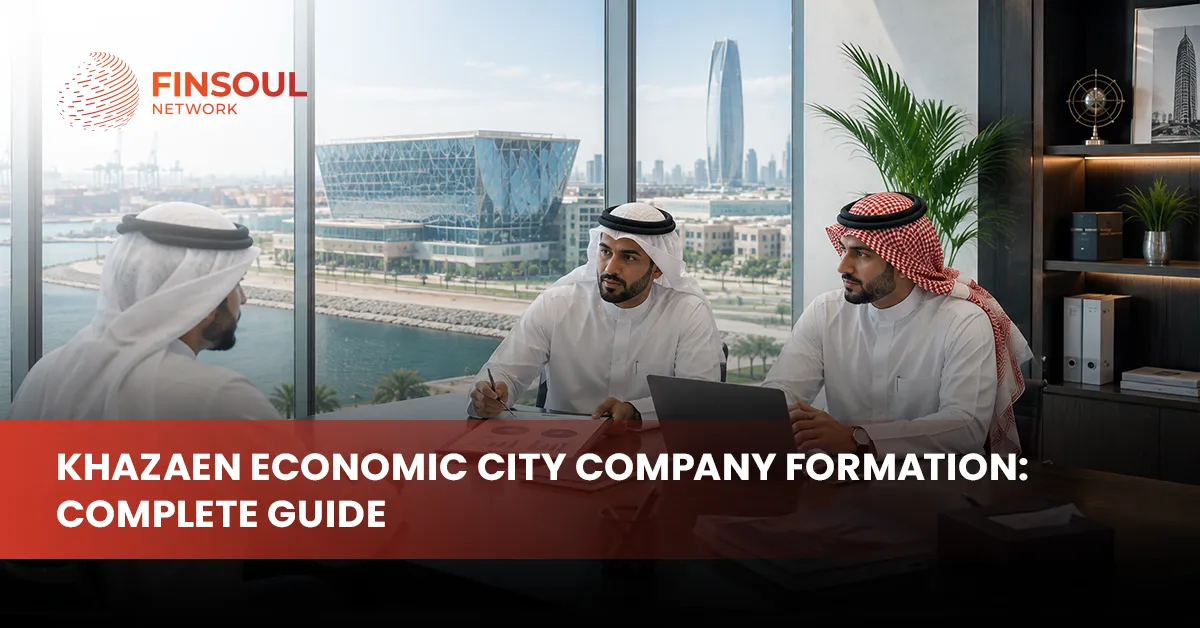
Khazaen Economic City Company Formation: Complete Guide
Khazaen Economic City is becoming an increasingly important location for businesses that need more than a commercial address in Oman. Its combination of industrial land, logistics infrastructure, warehousing, a dry port, designated free-zone areas and direct road links to Greater Muscat makes it particularly relevant to manufacturing, distribution, food, logistics and trade businesses.
But Khazaen Economic City company formation is not simply a matter of registering a company and selecting a licence. Investors need to distinguish between the wider economic city and the free zones established within it, understand where their proposed activity fits, determine whether land is required, and check the tax, VAT, workforce and regulatory rules that actually apply to their project.
What Is Khazaen Economic City in Oman?
Khazaen Economic City is an integrated industrial, logistics and commercial development in Barka, South Al Batinah Governorate, within the Greater Muscat area. It is supervised by the Public Authority for Special Economic Zones and Free Zones, commonly known as OPAZ.
Royal Decree 44/2023 formally established Khazaen Economic City and created two free zones within the city. That distinction is important: Khazaen Economic City and its designated free-zone areas are related, but investors should not assume that every business operating anywhere in Khazaen automatically receives the same free-zone, tax or customs treatment.
Why Does Khazaen Matter for Business Setup in Oman?
Khazaen is particularly relevant where a company’s business model depends on movement of goods, industrial space, storage, processing or access to Muscat and Oman’s wider transport network. Its value comes from combining different parts of the supply chain in one economic location.
- Strategic Barka location: Khazaen sits close to the Al Batinah Expressway and within the wider Greater Muscat economic area
- Dry-port access: Khazaen Dry Port provides customs, cargo-handling, storage, consolidation and logistics functions for domestic and international trade
- Industrial infrastructure: The city accommodates light and medium industries, manufacturing, assembly, packaging, repairs and maintenance
- Warehousing capacity: Its investment areas include cold stores, food storage, building-material storage, distribution centres and bulk-handling operations
- Business facilities: Corporate offices, financial businesses, IT-related operations and general commercial services can form part of the wider development
- Integrated supply chains: Industrial, food, logistics, commercial and supporting infrastructure can operate within the same wider economic ecosystem
Khazaen Economic City or Khazaen Free Zone: What Is the Difference?
The wider Khazaen Economic City should not be treated as identical to the free zones located inside it. Royal Decree 44/2023 established the economic city as well as two free zones within its masterplan, so the precise location of a proposed company or project can affect the rules and incentives relevant to it.
This distinction is particularly important when reviewing tax, customs and VAT treatment. Investors should confirm whether their proposed premises or plot sits within a designated free-zone area and whether the business satisfies the conditions attached to any particular incentive rather than applying a general “free-zone” assumption to the whole city.
What Businesses Can Operate in Khazaen Economic City?
Khazaen accommodates a broad range of activities, but its strongest commercial fit is with industrial, logistics, warehousing, food, distribution and businesses that benefit from physical infrastructure. Khazaen’s published investment opportunities also extend to offices, retail and supporting commercial activities.
Manufacturing and Industrial Businesses
Khazaen provides space for light and medium manufacturing, assembly, packaging, repairs and maintenance. These projects normally require closer assessment of land, utilities, production processes, environmental requirements and the approvals needed before operations begin.
Logistics and Warehousing Businesses
Warehousing, freight forwarding, cold storage, cargo distribution and bulk handling fit directly into Khazaen’s logistics model. Access to the dry port can also support businesses moving goods between inland storage, ports, airports, road networks and final destinations.
Food and Agri-Business Operations
Khazaen has developed a dedicated food ecosystem linked to Food City and the Central Fruits and Vegetables Market. This can be relevant to wholesalers, food processors, cold-chain operators, distributors and companies working across the food supply chain.
Which Legal Structures Can Be Registered in Khazaen?
Companies established under the OPAZ framework can use several legal forms, so the appropriate structure depends on the shareholders, ownership model, activity and long-term plans of the business. OPAZ’s current registration guidance recognises the following forms.
Legal form | Typical use |
Limited Liability Company | Privately owned operating businesses |
One-Person Company | Businesses with a single qualifying shareholder |
General Partnership | Businesses formed by general partners |
Limited Partnership | Partnerships with different liability arrangements |
Joint Venture | Qualifying collaborative business arrangements |
Joint Stock Company | Larger corporate structures |
Holding Company | Ownership of subsidiaries or investments |
Sole Proprietorship | Eligible individually owned businesses |
Branch | Qualifying local or foreign company branches |
Can Foreign Investors Own 100% of a Khazaen Company?
Full foreign ownership can be available within OPAZ-supervised zones, subject to the company’s legal form, activity and applicable regulatory framework. OPAZ currently lists 100% foreign ownership and full repatriation of capital and profits among its principal investor incentives.
Foreign investors should still verify whether the proposed activity is subject to any separate restrictions, approvals or sector-specific conditions. Foreign corporate shareholders may also need notarised and attested corporate documents as part of the company-registration process.
How Does Khazaen Economic City Company Formation Work?
The process has two connected parts: establishing the business legally and, where required, securing the project location within Khazaen. A land-intensive industrial project therefore follows a different practical journey from a business that only needs company registration and commercial premises.
- Choose the activity and location: Determine what the company will do and whether the project belongs in the economic city, a designated free-zone area or another Oman location
- Select the legal structure: Decide whether the company will operate as an LLC, one-person company, branch or another permitted structure
- Prepare shareholder documents: Collect identification and any notarised or attested corporate documents required for foreign shareholders
- Complete company registration: OPAZ states that registration can be made through the Oman Business Portal or a Sanad Service Centre
- Pay registration charges: Applicable company, chamber and administrative fees need to be completed as part of registration
- Obtain the registration documents: Following review, the company receives its registration number and relevant certificates
- Complete activity-specific licensing: Industrial, environmental, construction, food, logistics or other approvals may still be required before operations can begin
How Does the Khazaen Investment and Land Allocation Process Work?
Businesses requiring land in Khazaen go through an investment assessment and allocation process in addition to normal company registration. Khazaen currently describes four stages in its published investment flow.
- Investment application: The investor submits project information and supporting documents for assessment
- Application review: Khazaen states that its team evaluates the investment application within five working days
- Land allocation: A suitable plot is identified according to the project’s nature and specific requirements
- Lease agreement: The applicant proceeds with the applicable agreement after the commercial terms are agreed
- Project implementation: Company licensing, approvals, construction, utilities and operational requirements are completed according to the project
What Documents May Be Required for Khazaen Company Formation?
The document list changes according to the shareholder type, business activity and whether the investor is also applying for project land. Corporate investors and industrial projects generally require more supporting information than a straightforward individual application.
- Shareholder identification: Passport copies for non-Omani shareholders and applicable identification for Omani shareholders
- Foreign corporate documents: Notarised and attested corporate records where a shareholder is an overseas company
- Commercial registration documents: Existing company records where an established entity is making the investment
- Financial information: Khazaen’s investment materials may request corporate financial statements or shareholder financial evidence
- Project details: Information about the proposed operation, investment value, workforce, land requirements and implementation plans
- Manufacturing information: Industrial projects may need to explain their manufacturing process and technology
- Business supporting documents: A business plan, feasibility study or other project evidence may be requested where relevant
What Tax and Customs Incentives Are Available in Khazaen?
Tax and customs incentives can be significant within OPAZ-supervised zones, but investors should verify their eligibility instead of assuming every Khazaen company receives every advertised benefit. OPAZ generally highlights corporate tax exemptions for qualifying businesses, customs benefits, foreign ownership and capital repatriation across its zone framework.
The exact treatment depends on the location, activity, qualifying conditions and legislation applicable to the company. This is particularly important in Khazaen because the economic city contains specifically designated free zones rather than the entire city necessarily operating under one identical incentive regime.
Does Khazaen Economic City Have 0% VAT in 2026?
Investors should not currently assume that a business in Khazaen automatically qualifies for zero-rated Special Zone VAT treatment. This is an area where generic free-zone information can easily produce an incorrect conclusion.
The Oman Tax Authority’s current VAT Guide for Special Zones lists Al Mazunah Free Zone, Sohar Free Zone, Salalah Free Zone and Duqm Special Economic Zone as the recognised Special Zones for VAT purposes at the date of the guide. Khazaen is not included in that current list, meaning its VAT treatment should be checked against the exact transaction and current Tax Authority status rather than treated as automatically zero-rated.
What Are the Omanisation Requirements in Khazaen?
Workforce localisation needs to be included in the business plan from the start because Khazaen can have a higher Omanisation requirement than some other OPAZ locations. OPAZ currently states that Omanisation rates across its zones generally range from 10% to 35%.
Its current guidance specifically notes that Khazaen Economic City and Madayn Industrial Cities can have Omanisation rates up to 35%, depending on the zone and operational requirements. Companies should therefore confirm the rate applicable to their activity before finalising staffing and labour-cost forecasts.
How Much Does Company Formation in Khazaen Cost?
There is no meaningful single setup cost that applies to every Khazaen company. A basic company registration and a land-intensive manufacturing operation can have fundamentally different cost structures.
- Company registration fees
- Oman Chamber-related fees where applicable
- Zone administrative charges
- Business and sector licences
- Land lease or usufruct costs
- Warehouse, factory or office premises
- Construction and fit-out
- Utilities and infrastructure connections
- Environmental or technical approvals
- Employment and immigration costs
- Professional and document-attestation expenses
- Annual renewal and compliance costs
How Long Does Khazaen Company Formation Take?
The five-working-day period published by Khazaen applies to evaluation of an investment application, not to completion of the entire company setup. The final timeline depends on the entity, activity, premises, land and regulatory approvals involved.
A relatively simple commercial setup can have fewer dependencies than an industrial project requiring plot allocation, environmental clearance, construction, utilities and operating licences. Investors should therefore separate the initial application review time from the overall time required for the business to become operational.
What Should You Check Before Choosing Khazaen?
Khazaen is most useful when its location and infrastructure solve a real operational requirement for the business. Comparing the city only on headline incentives can overlook costs or practical issues that matter more once operations begin.
- Business activity fit: Check that the proposed activity is permitted and suitable for the selected part of Khazaen
- Economic city or free zone: Confirm exactly where the company or project will be located and which legal regime applies
- Customer base: Determine whether customers will mainly be in Oman, elsewhere in the GCC or international markets
- Land requirement: Establish how much space the project needs now and whether future expansion is likely
- Logistics model: Map imports, exports, storage, customs clearance and domestic distribution requirements
- Tax position: Verify corporate tax, customs and VAT treatment rather than relying on general promotional incentives
- Workforce planning: Confirm Omanisation and expatriate labour requirements for the proposed activity
- Approvals: Identify industrial, food, environmental, construction or other sector approvals before committing capital
- Total operating cost: Compare registration, premises, logistics, utilities, labour and compliance costs rather than setup fees alone
What Is New in Khazaen Economic City in 2026?
Khazaen is continuing to move from infrastructure development into active industrial investment, with new projects still being signed in 2026. This makes current information more important than relying on older brochures or historic free-zone summaries.
On 26 April 2026, OPAZ announced four new investment agreements in Khazaen Economic City with combined investment exceeding OMR 12.8 million. The projects covered manufacturing and pharmaceutical-related activities and formed part of a wider package of more than OMR 200 million in investments across Oman’s economic and free zones.
Is Khazaen Economic City the Right Location for Your Company?
Khazaen can be a strong option for companies that gain measurable value from industrial land, warehousing, dry-port connectivity, food-sector infrastructure or access to Greater Muscat. Its advantages are particularly tangible when logistics and physical operations form a major part of the business model.
It should not, however, be selected simply because an investor wants a “free-zone company”. The better comparison is between the company’s actual operational requirements and what Khazaen, Sohar, Duqm, Salalah, Madayn or an Oman mainland setup can provide.
Final Takeaway
Khazaen Economic City company formation makes the most sense when the location supports the economics of the business itself. Investors should first establish where within Khazaen they intend to operate, which legal structure fits the shareholders, whether land is required, what approvals apply and how tax, VAT and Omanisation rules affect the project.
For businesses researching company formation and investment options in Oman, Finsoul Network Oman can be used as a broader reference point alongside current OPAZ, Khazaen and Oman Tax Authority guidance when comparing the regulatory and practical considerations involved in establishing a business.
Frequently Asked Questions About Khazaen Economic City Company Formation
Is Khazaen Economic City a Free Zone?
No. Khazaen Economic City and its free zones should not be treated as exactly the same thing. Royal Decree 44/2023 established Khazaen Economic City and two free zones within it, so investors need to confirm the precise location and regime applying to their proposed project.
Can a Foreigner Set Up a 100% Owned Company in Khazaen?
Full foreign ownership can be available under the OPAZ investment framework, and OPAZ promotes 100% foreign ownership as one of its principal zone incentives. The final position still depends on the company’s activity, legal form and any sector-specific restrictions or approvals.
Does Every Khazaen Company Receive a Corporate Tax and VAT Exemption?
No. Investors should separate general OPAZ incentives from the exact tax treatment of their own company. In particular, the Oman Tax Authority’s current Special Zones VAT guide does not list Khazaen among the four recognised Special Zones for VAT purposes, so 0% VAT should not be assumed automatically.
Do I Need to Lease Industrial Land to Register a Company in Khazaen?
Not every business has identical land requirements. Khazaen accommodates industrial, logistics, office, commercial and other activities, while projects requiring dedicated plots go through its investment application, land-allocation and lease process. The appropriate premises therefore depend on what the business actually intends to do.
Is Khazaen Better Than Sohar, Duqm or Salalah for Company Formation?
There is no single best economic zone for every investor. Khazaen is particularly attractive for businesses that value proximity to Greater Muscat, Barka, inland logistics, warehousing and the Khazaen Dry Port, while Sohar, Duqm and Salalah have different port, industrial, geographic and incentive characteristics. The correct choice depends on the company’s customers, cargo routes, land needs, tax position and operating model.
Table of Contents
Book An Appointment
No Comments