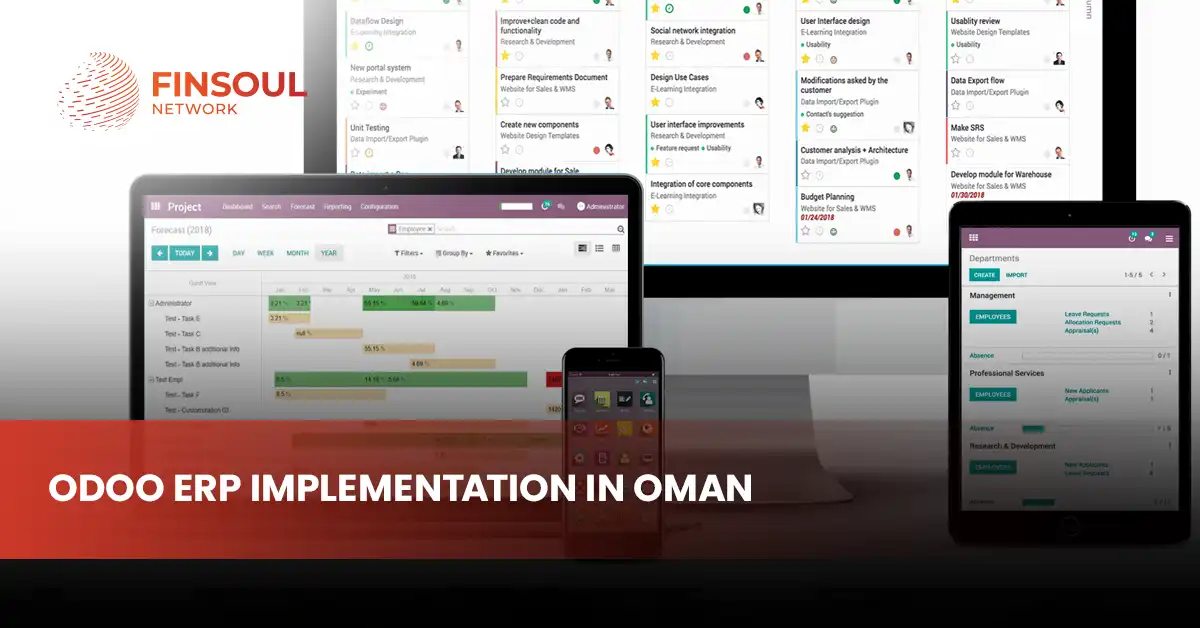

Odoo ERP Implementation in Oman
Businesses across Oman are under growing pressure to modernise how they operate. Manual processes, disconnected systems, and limited visibility into real-time performance are no longer sustainable for companies competing in a market shaped by Oman Vision 2040’s digital transformation agenda.
Enterprise Resource Planning systems have become the practical solution for businesses looking to centralise operations, improve reporting, and scale without adding unnecessary complexity. Among the available options, Odoo has gained significant traction in Oman’s SME and mid-market segments, largely because of its modular design, cost-effectiveness, and flexibility across industries. With the expertise of Finsoul Network Oman, businesses can implement Odoo ERP with confidence, ensuring compliance, scalability, and seamless integration tailored to the Omani market.
What Is Odoo ERP?
Odoo is an open-source business management platform that brings core business functions, including accounting, sales, inventory, HR, and customer management, into a single integrated system. It is used by businesses ranging from small startups to large enterprises across more than 100 countries.
Unlike legacy ERP systems that require significant upfront investment and lengthy implementation cycles, Odoo is modular by design. Businesses activate only the functions they need and add modules as requirements grow, making it accessible at earlier stages of business development and easier to scale over time.
Why Businesses in Oman Choose Odoo ERP
For Omani startups and SMEs, technology is no longer optional; it is the backbone of growth, compliance, and customer service. As companies scale, they need systems that unify operations, reduce manual work, and meet regulatory requirements. Odoo ERP has become the preferred choice because it offers flexibility, affordability, and localisation features that align with Oman’s evolving business landscape.
- Affordable implementation: Odoo’s modular pricing means businesses pay for what they use rather than a full enterprise licence, regardless of need
- Modular architecture: Modules can be activated incrementally as the business grows, avoiding unnecessary complexity at early stages
- Easy scalability: The platform grows with the business without requiring a system replacement
- Flexible deployment: Cloud hosting suits businesses seeking lower IT overhead; on-premise suits those with specific data or security requirements
- Open-source flexibility: Customisation is possible at the code level, giving businesses control that proprietary systems do not offer
- SME and enterprise suitability: The platform serves businesses across a wide size range without requiring a different product
- Arabic language support: Essential for Omani businesses managing local operations and government-facing documentation
- Multi-company and multi-currency capabilities: Support groups operating across Oman and international markets
Core Odoo Modules for Businesses in Oman
Omani startups and SMEs benefit from Odoo ERP because it offers modular flexibility; businesses can start small and expand as operations grow. The following modules are most relevant for companies in Oman, balancing compliance, efficiency, and scalability.
- CRM: Manages leads, opportunities, and customer relationships with pipeline tracking and automated follow-up
- Sales Management: Handles quotations, orders, pricing, and customer invoicing in a single workflow
- Accounting: Covers invoicing, bank reconciliation, financial reporting, and VAT management with Oman-specific localisation
- Inventory: Tracks stock movements, warehouse locations, and product availability in real time
- Purchase: Manages supplier orders, goods receipts, and vendor performance
- Manufacturing (MRP): Plans production orders, manages bill of materials, and tracks work centre capacity
- Human Resources and Payroll: Handles employee records, leave management, and payroll processing
- Project Management: Tracks tasks, deadlines, resources, and project profitability
- Helpdesk: Manages customer support tickets with SLA tracking and escalation workflows
- Website and eCommerce: Enables online storefronts that integrate directly with inventory and accounting
Odoo ERP Implementation Process
Implementing Odoo ERP requires a structured approach to ensure smooth adoption, compliance, and long‑term success. Businesses in Oman and across the GCC benefit most when the process is carefully planned and executed.
Step 1: Business Requirement Analysis
Document current processes, identify pain points, and define the outcomes the business expects from implementation.
Step 2: Selecting the Right Modules
Choose modules based on actual business needs rather than activating everything available. Starting lean reduces complexity.
Step 3: Project Planning
Establish timelines, assign responsibilities, define milestones, and set a realistic budget before any configuration begins.
Step 4: System Configuration
Configure Odoo to reflect the business’s structure, workflows, chart of accounts, and operational rules.
Step 5: Customisation
Develop any additional functionality required that the standard platform does not cover, keeping scope as narrow as possible.
Step 6: Data Migration
Clean and migrate data from existing systems, including customer records, product catalogues, and historical transactions.
Step 7: Third-Party Integrations
Connect Odoo with other platforms the business relies on, such as payment gateways, logistics systems, or government portals.
Step 8: User Acceptance Testing
Allow end users to test the configured system against real business scenarios before go-live, capturing and resolving issues.
Step 9: Employee Training
Train all user groups on the modules they will use daily, with role-specific guidance rather than generic platform overviews.
Step 10: Go-Live
Switch from existing systems to Odoo, with close monitoring during the initial period to catch and resolve early issues.
Step 11: Post-Implementation Support
Maintain access to technical and functional support for the period following go-live, when user questions and system refinements are most frequent.
Benefits of Odoo ERP Implementation
Implementing Odoo ERP gives startups and SMEs in Oman a unified platform to manage operations efficiently. Its modular design, scalability, and localisation features make it a powerful tool for businesses aiming to grow while staying compliant.
- Centralised operations: All business functions are accessible through a single platform, eliminating data silos
- Real-time reporting: Management dashboards and financial reports generated without manual data collection
- Better inventory control: Accurate stock levels reduce overordering and prevent stockouts
- Improved customer management: Full customer history, communication records, and sales pipeline visibility in one place
- Increased productivity: Automated workflows reduce manual tasks and the time spent on administrative processes
- Cost reduction: Consolidating multiple software subscriptions and reducing manual errors lowers operational costs
- Business scalability: New modules and users can be added as the business grows without a system change
Odoo ERP Implementation Timeline
- Small Business (under 20 users): Typically two to four months for standard module implementation with limited customisation
- Medium Business (20 to 100 users): Generally four to eight months, depending on the number of modules and integration requirements
- Large Enterprise (100-plus users): Eight to fourteen months for complex multi-department implementations with significant customisation and data migration
Factors that affect implementation time include the volume of data being migrated, the number of integrations required, the extent of customisation, and how quickly the internal project team can make decisions and complete testing.
Odoo ERP Implementation Cost in Oman
Implementation cost is determined by several variables rather than a fixed price:
- Number of users: Licensing costs are typically calculated per user
- Required modules: More modules increase both licensing and configuration costs
- Customisation scope: Bespoke development is the most variable and often the largest cost component
- Data migration complexity: The volume and condition of existing data affects migration effort significantly
- Third-party integrations: Each integration adds development and testing time
- Training requirements: More users across more roles increases training investment
- Ongoing support: Post-go-live support contracts vary by provider and scope
- Hosting: Cloud hosting costs are ongoing; on-premise involves upfront infrastructure investment
Businesses should request detailed scoping proposals from implementation partners rather than relying on headline figures that rarely reflect actual project requirements.
Odoo ERP and Oman Compliance
Implementations should be reviewed by a qualified Omani tax and accounting professional to confirm that the configuration meets all applicable obligations.
- Oman VAT requirements: Odoo’s accounting module supports VAT configuration aligned with Oman Tax Authority requirements, including tax codes and VAT return reporting
- Accounting localisation: Chart of accounts and financial reporting can be configured to meet local standards
- Financial reporting: Profit and loss, balance sheet, and cash flow reports are generated within the system
- Tax configuration: Multiple tax rates and exemption categories can be configured to reflect business-specific VAT obligations
- Future e-invoicing readiness: Odoo’s architecture supports integration with electronic invoicing frameworks as regulatory requirements develop
- Audit trails: All transactions are logged with user, timestamp, and change history, supporting regulatory review and internal governance
Common Challenges During Odoo ERP Implementation
Even with its flexibility, Odoo ERP implementation can present hurdles that affect timelines, budgets, and user adoption. Recognising these challenges early helps businesses plan effectively and avoid costly setbacks.
- Poor planning: Undefined objectives and unrealistic timelines create avoidable delays and cost overruns
- Incomplete requirements: Gaps in the initial specification lead to rework during or after implementation
- Dirty data: Migrating inaccurate or duplicate records from legacy systems corrupts the new system from day one
- Excessive customisation: Over-engineering the platform increases cost, extends timelines, and complicates future upgrades
- Employee resistance: Users who are not engaged early enough resist adoption, reducing the return on investment
- Weak project management: Without a clear owner and escalation path, decisions stall and issues accumulate
- Lack of training: Undertrained users revert to manual workarounds, negating the value of the system
- Budget overruns: Scope creep and underestimated customisation are the most common drivers of cost exceeding plan
Best Practices for a Successful Odoo ERP Implementation
Implementing Odoo ERP is not just a technical project; it’s a strategic initiative that requires planning, leadership, and continuous optimisation. Businesses that follow structured best practices achieve smoother rollouts and stronger long‑term results.
- Define specific business goals before any configuration begins and measure progress against them throughout
- Use a phased implementation approach, starting with core modules and adding complexity incrementally
- Clean and validate data before migration rather than assuming it can be tidied up afterwards
- Keep customisation to the minimum necessary, using standard Odoo functionality wherever possible
- Train users early and involve them in testing so that the system reflects how they actually work
- Assign internal project champions in each department who take responsibility for adoption and feedback
- Monitor KPIs from go-live to confirm that the implementation is delivering the expected business outcomes
- Plan for continuous improvement rather than treating go-live as the end of the project
Measuring ROI After Odoo ERP Implementation
The return on investment from Odoo ERP can be measured across multiple dimensions of business performance. Reduced operating costs are achieved through process automation and system consolidation, eliminating duplicate work and manual inefficiencies. Faster order processing results from integrating sales, inventory, and invoicing into a single workflow, while improved inventory accuracy reduces write‑offs and stock discrepancies.
Sales growth is supported by better pipeline management and enhanced customer visibility, and customer satisfaction rises thanks to quicker response times and accurate order fulfilment. Productivity gains are evident in the reduction of manual tasks and administrative time per transaction, while reporting speed improves as management gains on‑demand access to financial and operational data. Finally, decision‑making quality strengthens as managers act on real‑time insights rather than waiting for periodic reports, allowing businesses to respond faster and more strategically to market changes.
Future Trends in Odoo ERP
Odoo ERP is evolving rapidly, with new technologies shaping how businesses in Oman and beyond manage operations. Emerging innovations are making the platform smarter, more connected, and more adaptable to modern business needs.
- AI-powered automation is being integrated into Odoo workflows to predict demand, flag anomalies, and automate routine decisions
- Business intelligence tools within Odoo are becoming more sophisticated, enabling deeper analysis without external reporting platforms
- Predictive analytics help businesses anticipate inventory needs, customer behaviour, and financial performance
- IoT integration connects physical equipment and assets to ERP data for real-time operational visibility
- Mobile ERP access is increasingly expected, with Odoo’s mobile interface improving with each version release
- Cloud-first ERP is becoming the default deployment model as the reliability and security of cloud infrastructure improve
- Workflow automation continues to expand, reducing the manual steps involved in approval, notification, and reporting processes
Ready to Transform Your Business with Odoo ERP?
Successful ERP implementation requires the right partner who understands both technology and local compliance. Finsoul Network Oman specialises in guiding startups and SMEs through every stage of Odoo ERP adoption, from needs assessment to post‑implementation support, ensuring scalability, efficiency, and regulatory alignment.
Call us today at +968 7733 8545
Email: info@finsoulnetwork.com
Conclusion
Successful Odoo ERP implementation is not simply a matter of installing software. It requires a clear understanding of what the business needs to achieve, careful selection of the right modules, disciplined project management, thorough data preparation, and a commitment to training the people who will use the system every day.
For businesses in Oman, the additional layer of local compliance, VAT configuration, and Arabic language requirements makes choosing an experienced, locally grounded implementation partner even more important. The businesses that approach Odoo implementation as a strategic project rather than a technical exercise consistently achieve faster adoption, stronger return on investment, and a system that grows with them rather than requiring replacement as their needs evolve.
Frequently Asked Questions
What is Odoo ERP?
Odoo is an open-source business management platform covering CRM, accounting, inventory, HR, and more within a single integrated system.
Is Odoo suitable for SMEs in Oman?
Yes. Its modular pricing and flexible deployment make it well suited for SMEs that need professional ERP capability without enterprise-level cost.
How long does implementation take?
Between two and fourteen months, depending on business size, modules selected, and customisation requirements.
How much does an Odoo ERP implementation cost in Oman?
Cost depends on user count, modules, customisation, and support requirements. Detailed proposals from implementation partners provide the most accurate estimate.
Which Odoo modules should I implement first?
Accounting, inventory, and CRM are the most common starting points, as they deliver immediate operational visibility and address core business functions.
Can Odoo support Oman VAT requirements?
Yes, with proper configuration. Implementations should be reviewed by an Omani tax professional to confirm compliance.
Table of Contents
Book An Appointment
No Comments