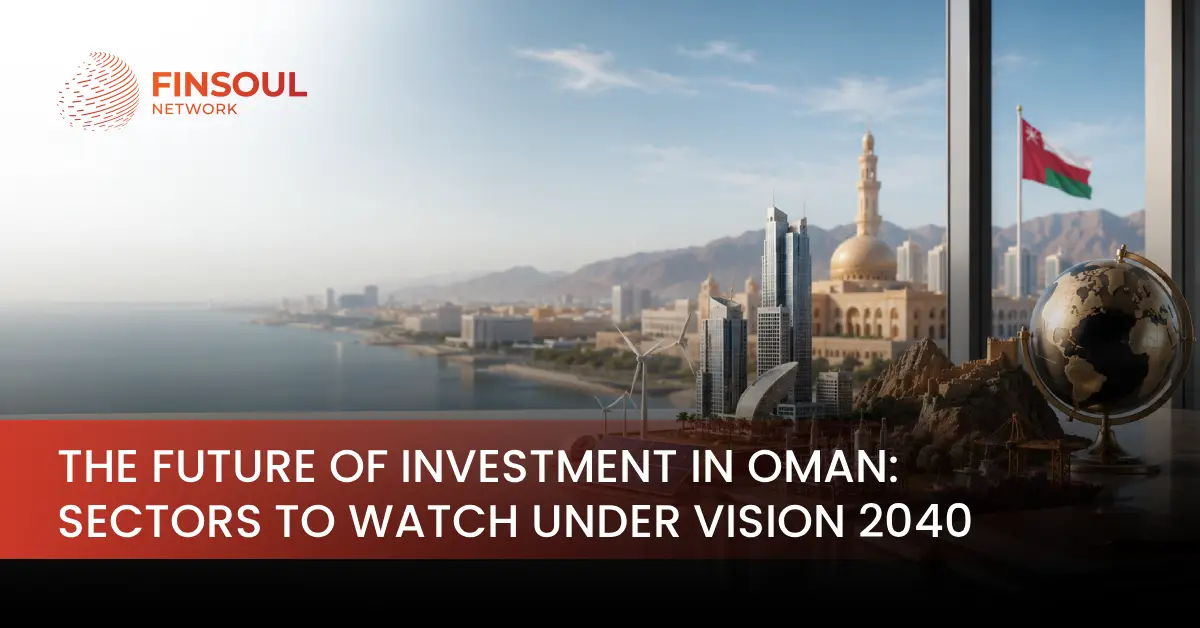
The Future of Investment in Oman: Sectors to Watch Under Vision 2040
Oman is undergoing one of the most significant economic transformations in its modern history. Driven by Vision 2040, the government’s long-term national development strategy, the Sultanate is actively diversifying away from oil dependency and building a broader, more resilient economy anchored in private enterprise, foreign investment, and innovation.
For investors, 2026 represents a particularly compelling entry point. Regulatory reforms have removed longstanding barriers to foreign ownership, digital infrastructure has improved the ease of doing business, and sustained government investment in priority sectors is generating tangible commercial opportunities across industries. Whether you are an individual investor, an SME, or a multinational corporation evaluating market entry, understanding where Oman is heading under Vision 2040 is the starting point for any serious investment decision. Finsoul Network Oman covers the sectors offering the strongest long-term potential, the government initiatives supporting investors, and the practical steps to begin investing in Oman with confidence.
Understanding Oman Vision 2040
Oman Vision 2040 is the Sultanate’s national development blueprint, launched to guide economic and social transformation through to the year 2040. It sets out a comprehensive framework for reducing dependence on hydrocarbon revenues, growing the private sector, and improving living standards for Omani citizens through sustainable development. The strategy is built around four broad pillars: a diversified and sustainable economy, a knowledge-driven society, a responsible and effective government, and an environmentally conscious approach to development. Key economic goals include growing non-oil GDP to represent the majority of total economic output, increasing private sector employment, and positioning Oman as a competitive regional hub for trade, investment, and innovation.
Foreign direct investment (FDI) is central to the strategy. Oman has introduced investor-friendly reforms to attract international capital, including full foreign ownership rights in most sectors, streamlined registration processes, and incentive packages for priority industries.
Innovation, sustainability, and digital transformation are embedded throughout the strategy. Green energy, technology, smart infrastructure, and knowledge-based industries are all identified as critical drivers of Oman’s future economy.
Why Oman Is Becoming an Attractive Investment Destination
Oman’s appeal to investors in 2026 rests on a combination of structural advantages and recent policy reforms.
- Strategic geographic location: Oman sits at the intersection of key global shipping routes, connecting the GCC, South Asia, East Africa, and Europe. Its ports provide direct access to over two billion consumers within a four-hour flight radius.
- Political and economic stability: Oman has maintained one of the most stable political environments in the Gulf for decades, providing a consistent and low-risk operating environment for long-term investors.
- Investor-friendly reforms: Amendments to the Foreign Capital Investment Law now permit 100 per cent foreign ownership in most commercial sectors, eliminating the historical requirement for an Omani partner.
- Modern infrastructure: Investment in roads, ports, airports, digital networks, and utilities has created a reliable foundation for business operations across the country.
- Free zones and special economic zones: Oman operates several free zones, including the Sohar Free Zone, Salalah Free Zone, and Al Mazunah Free Zone, offering tax exemptions, customs relief, and simplified procedures for qualifying businesses.
- Growing support for foreign investment: The Oman Investment Authority and dedicated investor services platforms provide structured support for inbound investors at the national and sector levels.
High-Growth Investment Sectors
Renewable Energy and Green Hydrogen
Oman’s renewable energy ambitions are among the most significant in the Gulf. The country’s solar irradiance and wind resources are among the strongest globally, and the government has set ambitious targets for renewable capacity as part of its energy transition strategy.
- Solar and wind energy projects are advancing across the country, with large-scale utility projects under development and smaller distributed energy opportunities emerging in industrial and commercial applications.
- Green hydrogen is a flagship priority. Oman is positioning itself as a major global exporter of green hydrogen, with projects in development at Duqm and other strategic locations targeting production for European and Asian markets.
- Government sustainability initiatives including carbon reduction targets and renewable energy mandates are creating a clear regulatory framework that supports long-term project finance and investor confidence.
- Long-term investment potential in this sector is exceptional, with demand for clean energy expected to grow substantially through 2040 and beyond.
Logistics, Ports, and Transportation
Oman’s logistics sector benefits directly from its geography, and it remains one of the most consistently attractive sectors for infrastructure and commercial investment.
- Strategic shipping routes passing through the Arabian Sea and the Strait of Hormuz make Oman’s ports natural waypoints for global trade flows.
- Port expansion at Sohar, Salalah, and Duqm is ongoing, increasing capacity and creating new opportunities for port-adjacent logistics, warehousing, and distribution businesses.
- Warehousing and distribution facilities linked to Oman’s free zones are in high demand from regional traders and international manufacturers using Oman as a Gulf distribution base.
- Supply chain opportunities exist across cold chain logistics, last-mile delivery, freight forwarding, and customs advisory services as trade volumes grow.
- Regional trade hub potential positions Oman as a credible alternative or complement to established logistics hubs elsewhere in the Gulf.
Manufacturing and Industrial Development
Oman’s industrial cities, most notably the Sohar Industrial Port Area, provide purpose-built infrastructure for manufacturing investment with access to utilities, logistics, and export routes.
- Industrial cities provide ready-to-use land, utilities, and logistics connections for manufacturers across sectors.
- Value-added manufacturing in sectors such as aluminium processing, steel fabrication, and building materials is well-established and continues to attract new entrants.
- Petrochemicals remain a significant industrial sector, supported by Oman’s hydrocarbon base and the infrastructure concentrated around Sohar.
- Food processing is an emerging priority linked to Oman’s food security agenda, with government incentives available for qualifying projects.
- Export-oriented industries benefit from Oman’s free trade agreements and port access, enabling manufacturers to serve regional and international markets efficiently.
Tourism and Hospitality
Oman’s tourism sector is one of the fastest-growing in the Gulf, backed by sustained government investment and a genuinely distinctive product offering.
- Luxury tourism is growing rapidly, with high-end resort developments in Muscat, the Hajar Mountains, and coastal areas attracting international visitors and high-spending travellers.
- Eco-tourism is a particularly strong opportunity given Oman’s extraordinary natural landscapes, including the Wahiba Sands, Wadi Shab, and the Dhofar region’s monsoon-driven khareef season.
- Heritage tourism centred on Oman’s forts, ancient trade routes, and traditional crafts is being developed as a distinctive cultural product for international markets.
- Hotels and resorts across budget, mid-market, and luxury segments are all needed as visitor numbers grow, creating investment opportunities for developers and operators alike.
- Entertainment and leisure developments linked to Vision 2040’s social transformation agenda are creating new categories of tourism investment beyond traditional hospitality.
Mining and Mineral Resources
Oman is one of the most mineral-rich countries in the Arabian Peninsula, and the mining sector remains significantly underexplored relative to its potential.
- Copper deposits, particularly in the Hajar Mountains, have been mined since antiquity and continue to attract modern extraction and processing investment.
- Limestone, gypsum, and chromite are extracted for construction and industrial applications, with growing export demand from regional markets.
- Gold deposits have been identified in several locations and are attracting increased exploration activity.
- Investment incentives for mining companies include favourable licensing terms, infrastructure support, and access to Oman’s ports for mineral exports. The government has identified mining as a priority diversification sector under Vision 2040.
Technology and Digital Economy
Oman’s digital transformation agenda is creating investment opportunities across the full technology stack.
- ICT infrastructure investment is expanding broadband connectivity, data centre capacity, and telecommunications networks to support a growing digital economy.
- Artificial intelligence applications are being adopted across government services, healthcare, logistics, and financial services, creating demand for AI development, integration, and advisory services.
- FinTech is an emerging sector supported by the Central Bank of Oman’s regulatory sandbox, which allows financial technology companies to test products in a structured environment.
- Cybersecurity is a growing priority for both public and private sector organisations as digital transformation increases exposure to cyber risk.
- Data centres are in demand as cloud adoption grows and regional data sovereignty requirements drive localisation of digital infrastructure.
- Digital government initiatives are creating procurement opportunities for technology companies supporting the modernisation of public services.
Government Initiatives Supporting Investors
Oman’s government has put in place a comprehensive set of initiatives to attract and retain investment across priority sectors.
- Investment incentives including land grants, utility subsidies, and capital expenditure support are available to qualifying investors in priority sectors and free zones.
- Public-private partnerships (PPPs) across infrastructure, healthcare, education, and utilities provide structured investment frameworks with government-backed revenue streams.
- Tax incentives, including corporate income tax exemptions in free zones and preferential rates for qualifying industrial projects, reduce the overall cost of investment.
- Business-friendly regulations introduced through the Foreign Capital Investment Law reforms, the new Commercial Companies Law, and streamlined licensing procedures have reduced administrative barriers across the board.
- Digital government services through the Oman Business Platform provide online access to registration, licensing, and compliance services, reducing time and cost for investors and business owners.
Risks and Considerations Before Investing
Investing in any market carries risks, and Oman is no exception. Approaching the market with clear-eyed preparation reduces avoidable setbacks.
- Market research is essential before committing to a sector or structure. Understanding demand, competition, and the regulatory environment specific to your activity is a prerequisite for sound investment decisions.
- Regulatory compliance requirements vary significantly by sector. Healthcare, education, financial services, and telecommunications all carry specific licensing conditions that must be understood before entering.
- Sector-specific licensing timelines can be lengthy for regulated industries. Build approval timelines into your investment and launch planning.
- Competition in established sectors including trading, construction, and professional services is intensifying as Oman attracts more investors. Differentiated positioning is increasingly important.
- Economic trends including oil price movements, government spending cycles, and regional trade dynamics can affect demand in certain sectors. Diversification across activities or markets reduces exposure.
- Long-term investment planning aligned with Vision 2040 priorities is more likely to benefit from government support, public procurement, and sustained demand than short-term opportunistic positioning.
How to Start Investing in Oman
Investing in Oman offers unique opportunities thanks to Vision 2040 reforms, strategic location, and investor‑friendly policies. With full foreign ownership now permitted in most sectors, Oman has become a gateway for regional and international capital.
Choose the Right Investment Sector
Begin with a thorough assessment of the sectors aligned with your expertise, capital, and long-term objectives. Identify where Vision 2040 priorities and your commercial strengths intersect for the strongest strategic fit.
Select the Appropriate Business Structure
Evaluate the ownership, liability, and operational requirements of each legal structure available in Oman, including the LLC, branch office, free zone entity, and representative office, before committing to a form of incorporation.
Register Your Business
Submit your commercial registration application through the Oman Business Platform, ensuring all documentation is accurate, properly attested, and complete before submission to avoid delays.
Obtain Licences and Approvals
Identify all sector-specific licences and regulatory approvals required for your business activity and initiate these processes in parallel with registration wherever possible to minimise the overall timeline.
Open a Corporate Bank Account
Present your Commercial Registration Certificate, company documents, and shareholder information to your chosen Omani bank to open the corporate account required for business transactions.
Ensure Ongoing Regulatory Compliance
Maintain annual CR renewals, licence renewals, VAT compliance, labour registrations, and any sector-specific reporting obligations from the outset. Compliance management is an ongoing responsibility, not a one-time task.
Get External Support For Investment in Oman
Oman’s Vision 2040 reforms have opened the door for investors across renewable energy, logistics, technology, tourism, and manufacturing. With full foreign ownership permitted in most sectors and structured incentives available, now is the time to position your business for long‑term growth in the Sultanate. Finsoul Network Oman provides end‑to‑end advisory support, helping investors identify the right sector opportunities, navigate regulatory approvals, and establish compliant operations with confidence.
Email: info@finsoulnetwork.com
Phone: +968 7733 8545
Conclusion
Oman Vision 2040 is not simply a policy document. It is an active transformation programme reshaping the country’s economic landscape in real time. For investors, this transformation creates a window of opportunity across multiple high-growth sectors, supported by genuine regulatory reform, modern infrastructure, and a government committed to private sector-led growth.
The strongest investment decisions in this environment are those aligned with Vision 2040’s long-term priorities, made with a clear understanding of the regulatory requirements, and structured through the most appropriate legal and commercial framework for the activity in question. Short-term thinking and poorly planned market entry are the most common reasons investors fail to realise the potential Oman genuinely offers.
Frequently Asked Questions (FAQs)
Which sectors offer the highest investment potential under Vision 2040?
Renewable energy, logistics, tourism, technology, healthcare, and manufacturing are consistently identified as priority sectors under Vision 2040, with government investment, policy support, and sustained demand making them the strongest long-term opportunities for investors.
Can foreigners invest in these sectors?
Yes. Following amendments to the Foreign Capital Investment Law, foreign nationals can own 100 per cent of a business in most sectors. Certain regulated industries, including healthcare, financial services, and education, may retain specific participation or approval requirements.
What incentives are available for investors?
Incentives vary by sector and location but include corporate income tax exemptions in free zones, land grants in industrial cities, utility subsidies for qualifying manufacturers, and public-private partnership frameworks offering government-backed revenue visibility.
Are there opportunities for SMEs and startups?
Yes. Oman’s startup ecosystem is developing rapidly, with incubators, accelerators, and government programmes supporting early-stage businesses in technology, creative industries, and food security. The LLC and SPC structures are both well-suited to SME registration.
Which sectors are expected to grow the fastest by 2040?
Green hydrogen, renewable energy, technology, tourism, and logistics are projected to see the strongest growth over the Vision 2040 horizon, supported by government capital allocation, demographic trends, and global demand for clean energy and regional connectivity.
Table of Contents
Book An Appointment
No Comments