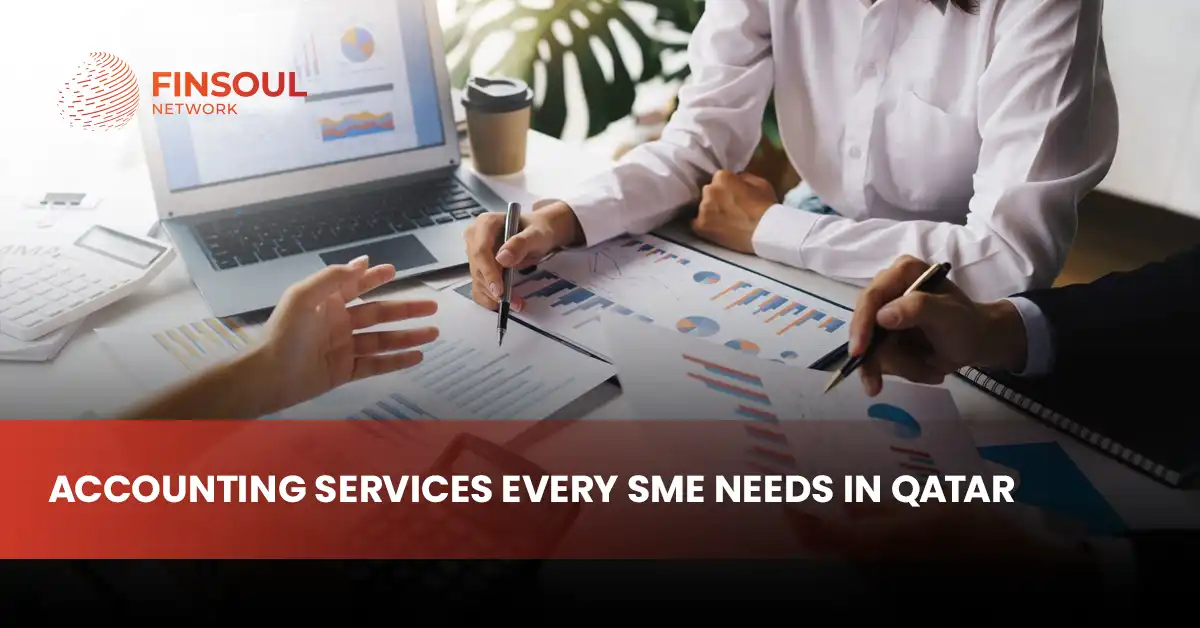

Accounting Services Every SME Needs in Qatar
Small and medium businesses in Qatar face a financial management challenge that larger organisations rarely encounter in the same way. They need professional-grade accounting capability to satisfy regulatory requirements, manage cash flow, and make informed decisions, but they typically lack the internal resources to build a full finance function from scratch. The result is that many SMEs either underinvest in accounting until a problem forces their attention, or they invest without a clear understanding of which services actually matter at their stage of growth.
Finsoul Network Qatar covers the accounting services that SMEs in Qatar genuinely need in 2026, how those needs evolve as the business grows, and how to choose the right provider to support both current operations and future ambitions.
Why Accounting Matters for SMEs in Qatar
Accounting is not an administrative function that businesses manage to satisfy regulators. It is the information system that tells management whether the business is performing as expected, where risks are accumulating, and whether the decisions being made are financially sound.
Better Financial Decision-Making
Decisions about hiring, pricing, investment, and expansion are only as good as the financial information they are based on. SMEs that maintain accurate, current accounts make better decisions faster than those operating with incomplete or outdated financial data.
Regulatory Compliance
Qatar’s regulatory environment places clear obligations on businesses regarding financial record-keeping, tax compliance, and financial statement preparation. Meeting these obligations requires structured accounting processes rather than reactive documentation assembled when deadlines arrive.
Cash Flow Management
Profitability and liquidity are not the same thing. Many SMEs that appear profitable on paper face cash shortages because their accounting does not give them adequate visibility into when money is coming in, when it is going out, and what the net position looks like over the coming weeks.
Business Growth
Investors, lenders, and potential business partners assess SMEs through their financial records. Businesses with well-maintained accounts and clear financial reporting consistently access growth capital more easily and on better terms than those without.
Investor and Lender Confidence
Banks and investors rely on financial statements to evaluate credit risk and business performance. SMEs that can produce accurate, timely, and professionally prepared accounts signal the management quality that financing relationships require.
Essential Accounting Services Every SME Needs in Qatar
The accounting services an SME needs depend on its size, sector, and stage of development, but several core services are relevant across most business types. The sections below explore each in detail, providing practical context for why each service matters and what it should deliver.
Bookkeeping Services
Bookkeeping is the foundation on which every other accounting service depends. Without accurate, current bookkeeping, financial statements are unreliable, payroll is error-prone, tax filings are inaccurate, and management has no clear picture of the business’s financial position.
Recording Daily Transactions
Every business transaction, whether a customer payment, supplier invoice, bank transfer, or expense claim, must be recorded accurately and promptly. Delays in recording transactions create backlogs that make financial reporting unreliable and reconciliations time-consuming.
Managing Accounts Payable and Receivable
Organised management of money owed to and by the business ensures that supplier payments are made on time, customer invoices are followed up consistently, and the business’s cash position is accurately reflected in its accounts at all times.
Bank Reconciliation
Monthly reconciliation of bank statements to the accounting records identifies discrepancies, catches errors, and provides assurance that the financial records accurately reflect actual cash movements. Unreconciled accounts are a common source of both financial errors and fraud.
Maintaining Accurate Financial Records
Complete, organised financial records are the prerequisite for every other accounting, tax, and audit requirement. Businesses that invest in good bookkeeping from the outset avoid the costly and time-consuming process of reconstructing records when they are needed.
Financial Statement Preparation
Financial statements are the primary output of the accounting process and the documents through which the business communicates its financial performance and position to management, regulators, lenders, and investors.
- Profit and loss statement: The primary measure of business performance, showing revenue, costs, and profit or loss over the reporting period. Monthly management accounts allow performance to be monitored and problems addressed before they affect annual results
- Balance sheet: A snapshot of the business’s assets, liabilities, and equity at a specific date, providing the information needed to assess financial strength and working capital position
- Cash flow statement: Shows how cash moved through the business during the period, distinguishing between operating, investing, and financing activities to reveal whether the business generates sufficient cash from its core operations
- Management reports: Tailored reports providing the financial insight that management needs for specific decisions, covering areas such as departmental profitability, cost variance analysis, and sales performance
Payroll Management Services
Payroll management is among the most operationally sensitive accounting functions for SMEs, combining financial accuracy with legal compliance and employee relations in ways that make errors particularly consequential.
- Employee salary processing: Accurate and timely calculation and payment of all employee salaries, allowances, and benefits in accordance with employment contracts and applicable labour law requirements
- Payroll records: Complete documentation of every payroll run, including salary calculations, deductions, and payment confirmations, maintained in a format that supports both internal management and regulatory review
- Leave and benefits management: Integration of leave balances, accruals, and benefits entitlements into payroll processing ensures that payments correctly reflect employees’ actual entitlements at each payment date
- Payroll compliance: Alignment of payroll processes with Qatar Labour Law requirements, including wage protection obligations and the documentation standards expected during labour inspections
Tax Compliance and Advisory
Tax compliance is an area where many SMEs in Qatar rely on reactive advice rather than proactive management, discovering obligations when deadlines are imminent rather than planning for them in advance.
- Understanding business tax obligations: Identifying which taxes apply to the business, including corporate income tax under Qatar Income Tax Law No. 24 of 2018, and understanding the filing, payment, and record-keeping requirements associated with each obligation
- Corporate tax compliance: Preparing and filing accurate tax returns on time, supported by the financial records and accounting schedules that substantiate each figure reported to the General Tax Authority
- Tax planning: Structuring financial decisions with awareness of their tax implications, taking advantage of legitimate deductions and exemptions, and managing the timing of transactions to support efficient tax outcomes
- Maintaining tax records: Keeping the detailed financial records required to support tax filings and withstand GTA review, retained for the minimum periods required under applicable legislation
- Preparing for regulatory changes: Monitoring developments in Qatar’s tax framework and assessing their implications for the business before changes take effect, rather than adapting reactively after deadlines have passed
Budgeting and Financial Planning
Budgeting and financial planning convert the historical information that accounting produces into forward-looking tools that guide business decisions and resource allocation.
- Annual budget preparation: A structured annual budget translates business objectives into financial targets for revenue, costs, and profitability, creating the baseline against which actual performance is monitored throughout the year
- Cash flow forecasting: Rolling cash flow forecasts, updated regularly, provide management with visibility into future liquidity and allow cash flow challenges to be identified and addressed before they become operational problems
- Financial projections: Medium-term financial projections support strategic planning, investment decisions, and financing applications by demonstrating the expected financial trajectory of the business under defined assumptions
- Cost control: Systematic analysis of cost structures identifies opportunities to improve efficiency, reduce unnecessary expenditure, and protect margins without compromising service quality or operational capability
- Business performance monitoring: Regular comparison of actual financial performance against budget and prior periods highlights variances that require management attention and informs decisions about where to focus improvement effort
Management Accounting and Business Reporting
Management accounting goes beyond the statutory reporting required for compliance to provide the operational financial intelligence that helps SME owners and managers run their businesses more effectively.
- KPI reporting: Regular reporting of the key financial and operational metrics that most directly reflect business performance, presented in a format that allows management to assess progress quickly and act on what the numbers reveal
- Profitability analysis: Analysis of profit margins by product, service, customer, or business unit identifies where value is genuinely created and where pricing or cost management improvements are needed
- Departmental performance: Where businesses operate across multiple functions or locations, financial reporting by department or division gives management the insight needed to hold each area accountable for its contribution
- Expense analysis: Systematic review of cost categories identifies trends, anomalies, and opportunities for efficiency improvement that aggregate financial statements do not reveal
- Decision support: Ad hoc financial analysis supporting specific management decisions, including investment appraisals, make-or-buy decisions, and pricing strategy reviews
Audit Support Services
External audits are a requirement for many SMEs in Qatar, and the quality of audit support services directly affects how smoothly the process runs and how much it costs.
- Preparing financial records: Ensuring that all accounting records are complete, reconciled, and organised before the audit commences, reducing the time auditors spend waiting for documentation and the cost of additional audit hours
- Supporting audit documentation: Compiling the schedules, reconciliations, contracts, and evidence that auditors require to test the financial statements, organised in a format that supports efficient review
- Resolving audit queries: Providing timely, accurate responses to auditor questions and information requests, keeping fieldwork on schedule and preventing delays caused by incomplete or slow responses
- Improving audit readiness: Building the ongoing record-keeping and internal control practices that make every future audit faster and less disruptive than the previous one
Accounting Services by Business Stage
Accounting needs are not static. They evolve as the business grows, and the services that are most important at one stage may not be sufficient at the next.
- Startups: Bookkeeping, basic financial statement preparation, payroll if employees are being hired, and tax registration are the immediate priorities. Cloud accounting software configured correctly from the outset prevents the costly reorganisation of records that many startups eventually face
- Small businesses: As transaction volumes increase and relationships with banks and suppliers become more complex, bank reconciliation discipline, accounts receivable management, and monthly management reporting become important alongside the foundational services
- Growing SMEs: Cash flow forecasting, budgeting, payroll compliance across a larger workforce, tax planning, and management accounting supporting more complex decisions become priorities as the business scales
- Expanding companies: Virtual CFO services, audit support, internal controls, IFRS-compliant financial reporting, and multi-entity or multi-currency accounting reflect the needs of businesses that have grown to a scale where financial management requires strategic leadership as well as operational accuracy
Common Accounting Mistakes SMEs Should Avoid
The accounting failures that most consistently damage SMEs in Qatar are predictable, avoidable, and disproportionately costly relative to the investment required to prevent them.
- Poor bookkeeping: Delayed, incomplete, or inaccurate recording of transactions produces financial statements that do not reflect reality and management decisions based on unreliable information
- Mixing personal and business finances: Combining personal and business transactions makes financial reporting unreliable, creates tax compliance complications, and is one of the most common causes of cash flow confusion
- Ignoring cash flow: Treating profitability as a proxy for liquidity leads businesses to run out of cash despite showing a profit, often with very little advance warning
- Delaying financial reporting: Producing financial information weeks or months after the period end removes its value for operational decision-making and creates audit preparation problems
- Weak internal controls: The absence of financial controls leaves businesses exposed to errors and fraud that proper segregation of duties and approval processes would prevent
- Inaccurate payroll: Payroll errors create employee dissatisfaction, regulatory exposure, and the administrative cost of correction that accurate payroll processing from the outset avoids
- Waiting until year-end to review finances: Annual financial reviews discover problems that monthly reviews would have caught early enough to address without significant consequence
How to Choose the Right Accounting Service Provider
Selecting the right accounting partner is a significant decision that affects the quality of financial management, compliance, and strategic support the business receives throughout its growth journey.
- Industry experience: Providers with experience in the SME’s sector understand the specific accounting challenges, regulatory requirements, and reporting needs that are relevant to the business
- Qualified professionals: Accounting services should be delivered by qualified accountants with relevant professional credentials and current knowledge of Qatari regulatory requirements
- Technology capabilities: The ability to work with modern cloud accounting platforms and provide real-time reporting reflects the operational standards that effective financial management requires
- Scalability: The provider should be able to grow with the business, offering additional services as needs evolve rather than requiring a change of provider as the business expands
- Communication: Regular, clear communication about financial performance, compliance deadlines, and emerging issues is as important as technical capability in an accounting relationship
- Transparent pricing: Clearly defined service scopes and fee structures prevent the scope creep and unexpected costs that damage accounting relationships
SME Accounting Advisory & Support
Accurate accounting is the foundation of SME growth in Qatar. From bookkeeping and payroll to tax compliance, cash flow forecasting, and audit preparation, our team ensures your business meets regulatory obligations while gaining the financial insight needed to grow confidently.
Email: info@finsoulnetwork.com
Final Thoughts
Effective accounting is not simply about maintaining financial records. It provides the controls, insights, and compliance foundation that SMEs in Qatar need to grow with confidence, manage risk, and demonstrate the financial management quality that clients, lenders, and regulators expect of established businesses.
SMEs that invest in accurate bookkeeping, timely reporting, sound internal controls, compliant payroll, structured tax management, and strategic financial planning consistently outperform those that treat accounting as a background function. Choosing an experienced accounting partner who understands Qatar’s regulatory environment and can scale services as the business evolves is one of the most valuable investments a growing SME can make.
Frequently Asked Questions
What accounting services do SMEs need?
Bookkeeping, financial statement preparation, payroll management, tax compliance, cash flow forecasting, and management reporting are the core services relevant to most SMEs. Additional services, including virtual CFO and audit support, become important as the business grows.
Is bookkeeping the same as accounting?
No. Bookkeeping is the process of recording transactions accurately. Accounting uses that data to prepare financial statements, analyse performance, support tax compliance, and provide management insight.
When should a business outsource accounting?
When internal capacity is insufficient to maintain accurate and timely financial records, when compliance deadlines are being missed, or when the business needs financial insight beyond what basic bookkeeping provides.
What financial reports should SMEs review monthly?
Profit and loss statement, balance sheet, cash flow statement, and a comparison of actual performance against budget are the minimum monthly reporting requirements for effective financial management.
Do SMEs need a virtual CFO?
Growing SMEs facing significant strategic decisions, preparing for external financing, or managing complex financial situations benefit significantly from virtual CFO expertise that operational accounting services do not provide.
.
Table of Contents
Book An Appointment
No Comments