
Internal controls services in Qatar play a vital role in safeguarding organizational assets, maintaining regulatory compliance, and supporting smooth day-to-day operations. As regulatory oversight continues to tighten, businesses face increased pressure to strengthen their internal processes and mitigate exposure to operational and compliance risks. Finsoul Network provides specialized support for developing, implementing, and evaluating internal control frameworks tailored to real-world business environments.
We work with organizations of all sizes, from emerging businesses to established enterprises, across multiple sectors. Our approach focuses on building practical and resilient control systems that align with current Qatari regulations while remaining flexible enough to adapt to future regulatory changes. Through structured reviews and detailed assessments, we help teams improve process discipline and operational clarity.
By minimizing procedural gaps and documentation errors, our services support consistent audit readiness and stronger governance. We help organizations across Qatar reinforce their internal control structures, reduce risk, ensure compliance, and enhance overall operational effectiveness across diverse industries.
Quick Navigation
Why Your Business Needs Internal Controls Services
Tightening regulatory oversight in Qatar means that weak internal controls are increasingly likely to surface in audits, inspections, and enforcement actions, rather than staying quietly hidden.
- Regulatory Expectation is Rising: Qatar’s Commercial Companies Law, QCB Regulations, and AML/CFT Law all impose specific internal control obligations that businesses must be able to demonstrate compliance with.
- Law specifically requires AML Controls: The Anti-Money Laundering Law No. 20 of 2019 requires companies to maintain robust internal controls to detect, monitor, and report suspicious transactions, with serious penalties for failure.
- Audit Readiness Depends on Controls: External auditors assess the quality of internal controls before determining the scope and depth of their audit, meaning weak controls directly increase audit cost and complexity.
- Governance Code Requirements: QFMA’s 2025 Governance Code mandates stronger governance structures, transparency, and risk management for listed companies, all of which depend on functioning internal control systems.
- Fraud Prevention: Internal control weaknesses are among the most common enablers of occupational fraud and financial misstatement in business environments where oversight is informal or inconsistent.
- Growth and Scalability: Businesses scaling operations, entering new markets, or bringing in investors need documented, functioning controls to satisfy due diligence requirements.
Internal Controls Services We Offer
We help Qatar businesses design, implement, and maintain internal control frameworks that are practical, regulation-aligned, and built to last.
We evaluate your current control environment and identify weaknesses against regulatory requirements and international standards.
We design or enhance internal control frameworks customised to your industry, size, and operational structure.
We provide hands-on assistance to integrate new controls into your day-to-day operations.
We rigorously test controls to confirm they are working as designed and recommend adjustments where needed.
We train key personnel to ensure controls are understood, adopted, and consistently applied.
We provide periodic reviews to keep your control environment current as your business and regulations evolve.
Industries We Serve in Scope of Our Internal Controls
Industries We Serve
- Banking & Financial Services: Strengthening internal controls to ensure secure, compliant, and accurate financial operations.
- Energy & Utilities: Enhancing control systems to protect critical infrastructure and manage operational risks.
- Healthcare: Verifying controls over patient data security and compliance with healthcare regulations.
- Construction & Infrastructure: Auditing controls for project management, procurement, and financial processes.
- Manufacturing & Industrial: Assuring process reliability and control over production and supply chain risks.
- Information Technology & Telecommunications: Implementing controls to safeguard IT assets and maintain data integrity.
- Government & Public Sector: Enhancing transparency and control over public funds and regulatory processes.
- Retail & Consumer Goods: Strengthening controls over inventory, cash handling, and customer data protection.
Relevant Laws, Standards, Or Industry Frameworks

Commercial Companies Law
Governs company incorporation, governance, financial reporting, and shareholder rights, establishing a foundation for internal controls in corporate entities operating in Qatar.

Qatar Financial Markets Authority (QFMA) Code of Market Conduct
Sets clear rules for market conduct and enhances regulatory oversight, supporting internal control measures in financial market operations.

Qatar Financial Centre Regulatory Framework
Provides procedural rules and regulatory standards for entities operating within QFC, ensuring transparency and compliance in financial and investment services.

Anti-Money Laundering and Combating Terrorism Financing Law (Law No. 20 of 2019)
Companies must maintain robust internal controls to detect, monitor, and report suspicious transactions, enhancing overall compliance efforts.

Qatar Central Bank (QCB) Regulations
Govern the banking sector, mandating stringent internal control and risk management processes to maintain financial stability.

Qatar National Vision 2030 and Corporate Governance Code
Emphasizes ethical management, transparency, and accountability, influencing internal control frameworks to support sustainable growth.
Key Benefits of Internal Controls Services in Qatar
Strong internal controls protect your business from financial, operational, and regulatory risk while building the governance foundation that supports sustainable growth.
- Reduced Fraud and Error Risk: Well-designed controls prevent both unintentional mistakes and deliberate manipulation from going undetected.
- Smoother External Audits: Strong internal controls reduce audit scope, complexity, and cost by demonstrating a reliable control environment to external auditors.
- Regulatory Compliance Confidence: Documented, functioning controls help you meet obligations under Qatar’s AML law, Commercial Companies Law, and QCB regulations.
- Stronger Governance Maturity: Internal controls underpin the governance structures increasingly required by regulators and expected by investors.
- Better Operational Efficiency: Control reviews often surface process inefficiencies that, once corrected, improve speed and accuracy across business functions.
- Investor and Stakeholder Confidence: Businesses with well-documented, independently reviewed controls are more credible to investors, lenders, and partners.
Book an Appointment with Us
Schedule a consultation with Finsoul Network Qatar Business Solutions and connect with our experienced business services team. We provide practical guidance, professional support, and reliable solutions to help improve your business operations, maintain compliance, and achieve your business goals with confidence.
Cost of Internal Controls Services in Qatar
Internal controls costs in Qatar depend on the size of your organization, the complexity of your operations, and the current maturity of your control environment. Below is an indicative breakdown for planning purposes.
Disclaimer: The costs listed above are indicative estimates only and may vary based on company size, scope of work, industry requirements, and the complexity of the engagement. For an accurate quote customised to your business, please contact our team for a detailed consultation.
Industries We Serve in Scope of Our Internal Controls
Industries We Serve
- Banking & Financial Services: Strengthening internal controls to ensure secure, compliant, and accurate financial operations.
- Energy & Utilities: Enhancing control systems to protect critical infrastructure and manage operational risks.
- Healthcare: Verifying controls over patient data security and compliance with healthcare regulations.
- Construction & Infrastructure: Auditing controls for project management, procurement, and financial processes.
- Manufacturing & Industrial: Assuring process reliability and control over production and supply chain risks.
- Information Technology & Telecommunications: Implementing controls to safeguard IT assets and maintain data integrity.
- Government & Public Sector: Enhancing transparency and control over public funds and regulatory processes.
- Retail & Consumer Goods: Strengthening controls over inventory, cash handling, and customer data protection.
Common Internal Control Failures in Qatar and GCC Businesses
Understanding where internal controls most commonly break down helps organizations prioritize the areas that need the most attention.
- Weak Segregation of Duties: One of the most frequently cited control weaknesses is allowing the same person to authorize, execute, and record financial transactions, creating conditions where errors or fraud go undetected.
- Inadequate Documentation: Missing approvals, unsigned contracts, and incomplete records are a leading cause of audit findings across Qatar businesses and result in difficulty demonstrating compliance during regulatory reviews.
- Poor IT General Controls: Weak user access management, insufficient backup processes, and lack of system change controls remain common gaps, particularly as businesses adopt more digital tools without updating control frameworks.
- Insufficient AML Transaction Monitoring: Common compliance failures identified across GCC enforcement cases include inadequate customer due diligence, poor transaction monitoring, failure to report suspicious activity, and outdated risk assessments.
- Absence of a Functioning Audit Committee: Many businesses, particularly SMEs and family-owned enterprises, lack formal governance structures such as audit committees or independent oversight, which is one of the challenges QFMA’s 2025 Governance Code addresses directly.
- Manual, Uncontrolled Processes: Overreliance on manual processes without formal documentation or review controls increases the risk of both unintentional error and deliberate manipulation.
- Insufficient Staff Training: Staff who are unaware of control requirements or who view them as administrative formality rather than operational necessity create systemic control gaps that are difficult to detect from the outside.
Process For Delivering Internal Controls Services
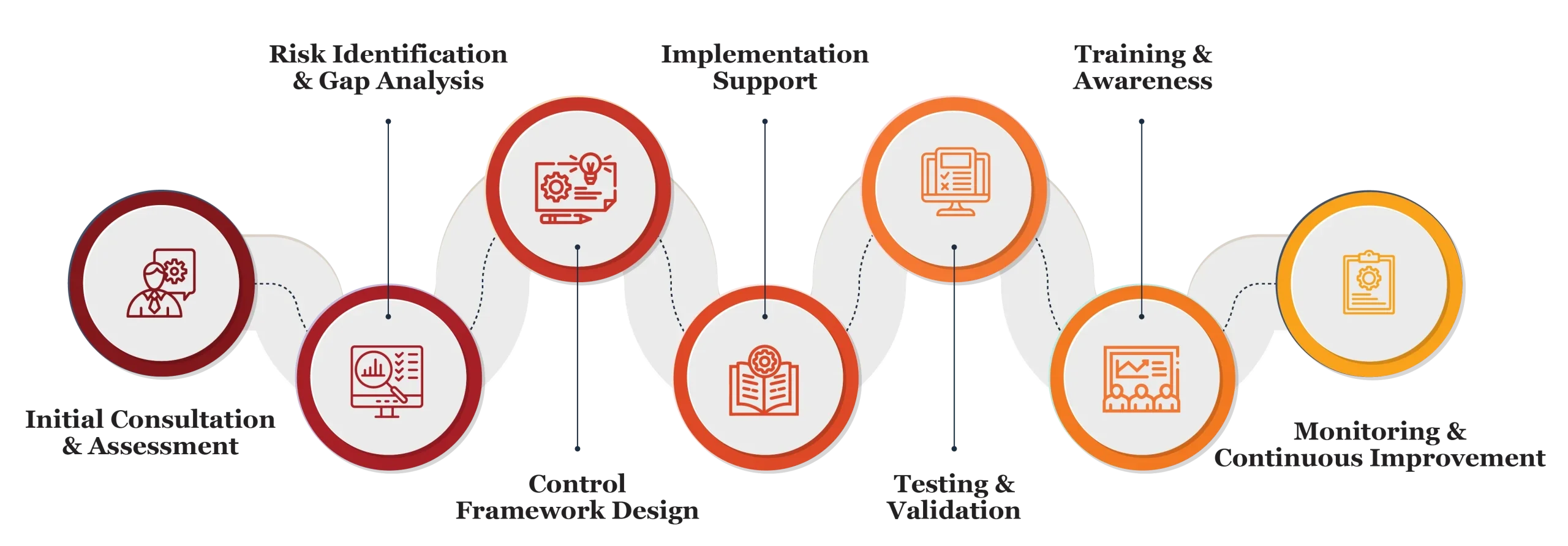
At Finsoul Network Qatar, we follow a structured and transparent process for internal control services:
- Initial Consultation and Assessment
We begin with an in-depth consultation to understand your business structure, operational risks, and existing control environment. - Risk Identification and Gap Analysis
We identify control weaknesses, operational inefficiencies, and regulatory risks through comprehensive evaluations and interviews. - Control Framework Design
Based on the assessment, we design or enhance your internal control framework aligned with Qatari regulations and international standards. - Implementation Support
We provide hands-on assistance to integrate the new or improved controls into your day-to-day operations. - Testing and Validation
Our experts conduct detailed testing to validate the effectiveness of the controls and recommend adjustments where needed. - Training and Awareness
We deliver training sessions to key personnel to ensure successful adoption and ongoing management of internal controls. - Monitoring and Continuous Improvement
Periodic reviews and updates help you maintain a dynamic and resilient control environment.
Project Timelines For Key Internal Controls Services in Qatar
While every engagement is tailored to client-specific needs, a typical timeline for internal controls projects with Finsoul Network in Qatar includes:
These timelines are estimates based on general project types. Actual durations may vary depending on your industry, organization size, and operational needs.
Why Choose Finsoul Network For Internal Controls Services in Qatar?
Finsoul Network delivers internal controls services in Qatar that are designed to work in practice, not just on paper. Our emphasis is on creating control frameworks that support everyday business activities while strengthening oversight and accountability.
We bring sector-specific insight across industries such as healthcare, financial services, and real estate, allowing us to design controls that are both relevant and effective. All solutions are developed in line with Qatar’s regulatory environment, helping organizations remain compliant, protected, and prepared for regulatory change.
By integrating strong internal controls within finance and accounting functions, we help improve data accuracy, protect organizational assets, and enhance operational flow. Our preventive approach focuses on identifying weaknesses early, limiting future exposure, and reducing avoidable costs. With a strong focus on implementation and outcomes, we provide practical control solutions that increase efficiency, reinforce compliance, and build long-term operational reliability.

Schedule a Consultation with Our Expert Team
Ready to move forward? Booking an appointment with our expert team is quick and easy. Whether you need a consultation, assistance with our services, or want to explore partnership opportunities, we are here to guide you every step of the way. Our dedicated team ensures a seamless experience, providing expert advice and tailored solutions to meet your needs. Schedule your appointment today and take the next step with confidence!
FAQ's:
