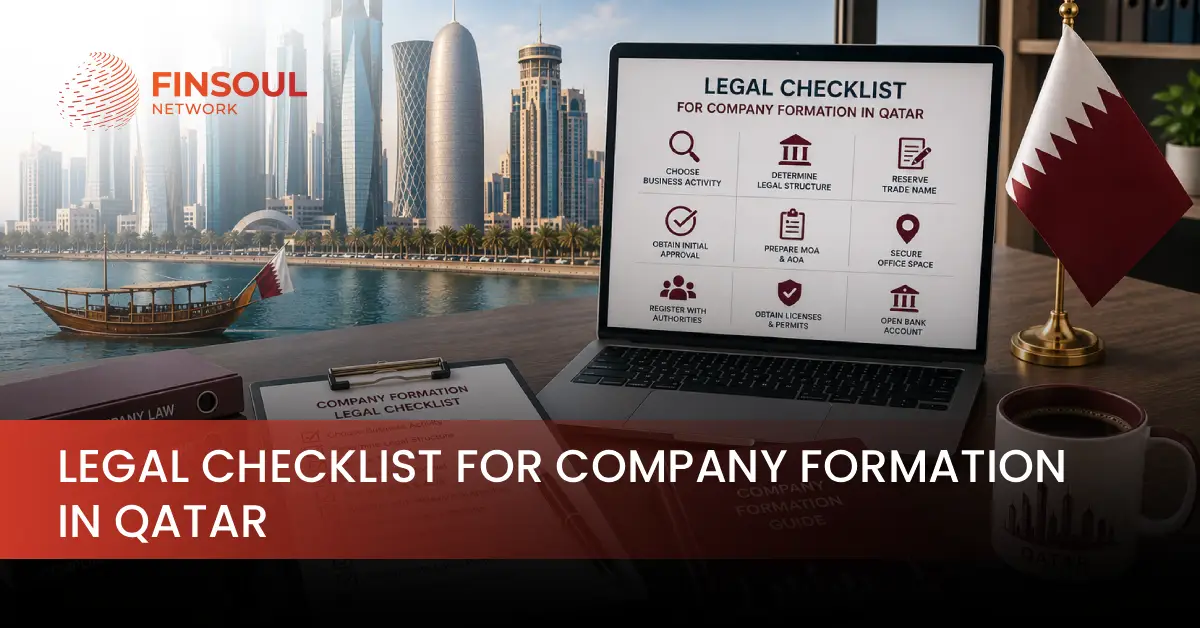

Legal Checklist for Company Formation in Qatar
Qatar has emerged as one of the most attractive destinations in the Gulf for entrepreneurs and investors looking to establish a business presence. With its stable economy, strategic location, and ongoing push toward economic diversification beyond oil and gas, the country continues to draw foreign capital into sectors such as technology, finance, healthcare, and trade. As foreign investment grows, so does the importance of understanding the legal landscape that governs company formation.
Setting up a business in Qatar is not just about registering a name and opening an office; it requires careful compliance with multiple regulatory bodies, ownership rules, and sector-specific approvals. Missing even one step can delay incorporation or expose a business to penalties later on. This guide, brought to you by Finsoul Network Qatar, walks through the complete legal checklist for forming a company in Qatar, from regulatory basics to post-incorporation obligations.
Regulatory Framework for Company Formation in Qatar
Company formation in Qatar refers to the legal process of registering, licensing, and operationalizing a business entity under Qatari law, allowing it to legally trade, hire employees, and open bank accounts.
Why Legal Clarity Is Essential Before Setup
Understanding the legal requirements before starting the process prevents wasted time, rejected applications, and costly restructuring later. Many investors lose months simply because they did not understand ownership rules or licensing categories upfront.
Key Regulatory Authorities
The Ministry of Commerce and Industry (MOCI) oversees commercial registration, the General Tax Authority (GTA) manages tax compliance, and local municipalities handle physical premises approvals, alongside sector regulators for specialized industries.
How the Legal Framework Impacts Business Success
A business built on a solid legal foundation faces fewer operational disruptions, smoother banking relationships, and greater credibility with partners and clients.
Legal Structures Available in Qatar
Choosing the right legal structure is one of the most important early decisions, as it determines ownership rights, liability exposure, and operational flexibility. The right choice depends on the nature of the business, the target market, and the level of control the investor wants to retain.
- Limited Liability Company (LLC): The most common structure for foreign investors, offering limited liability and flexibility across most sectors.
- Branch of a Foreign Company: Allows an existing international company to operate in Qatar under its parent entity, often used for specific contracts.
- Representative Office: Suitable for market research and liaison activities, but cannot engage in direct commercial trading.
- Joint Venture Company: A partnership structure between foreign and local entities, useful for sharing risk and local market expertise.
- Free Zone Entities: Allow full foreign ownership and tax incentives but restrict operations primarily to the free zone or international markets.
Business Activity Approval Process
Selecting the correct business activity is one of the most important steps in company formation in Qatar. Before a company can be registered, the proposed activity must be reviewed and approved by the Ministry of Commerce and Industry (MOCI), as it determines the licenses, approvals, and regulatory requirements applicable to the business.
Business activities in Qatar are classified as either regulated or non-regulated. Certain sectors, including banking, insurance, healthcare, education, and energy, require additional approvals from the relevant authorities before registration can proceed. Many investors face delays because they choose activity classifications that do not accurately reflect their intended operations. Defining the business activity correctly from the beginning helps streamline the registration process, prevents licensing complications, and supports future business growth.
Trade Name Registration Requirements
In Qatar, a trade name must be unique, non-conflicting with existing registrations, and free from offensive or religiously sensitive terms. It should also clearly reflect the approved business activity and cannot imply any government affiliation without authorization. All trade names are subject to approval by the Ministry of Commerce and Industry (MOCI), and applications are often rejected due to duplication, lack of clarity, or non-compliance with naming rules. Early reservation of a compliant trade name helps ensure a smoother registration process and prevents unnecessary delays.
Ownership Rules in Qatar
Ownership regulations are a key part of company formation in Qatar, as they determine who can own, control, and operate a business within the country.
Foreign Ownership Laws Explained
Qatar has progressively liberalized its foreign investment laws, allowing greater participation by international investors across most sectors.
100% Foreign Ownership Eligibility
In many sectors, foreign investors can now own up to 100% of their company without requiring a local Qatari partner, particularly within approved free zones and many mainland activities.
Qatari Partner Requirements (If Applicable)
Certain restricted or strategic sectors still require a Qatari national or entity to hold a minimum shareholding, so it is important to confirm activity-specific requirements before structuring ownership.
Shareholding Structure Planning
Investors should plan their shareholding structure early, factoring in future fundraising, profit distribution, and potential expansion into regulated sectors.
Commercial Registration (CR) Process
The Commercial Registration certificate is the core legal document confirming a company’s existence in Qatar. Processing typically takes a few weeks, though delays often arise from incomplete documentation or unclear activity descriptions, both of which can be avoided with careful preparation.
- Reserve and approve the trade name with MOCI.
- Draft and notarize the Memorandum of Association (MOA).
- Submit required documents, including passport copies, MOA, and proof of office address.
- Pay registration fees and obtain the Commercial Registration certificate.
- Register with the Chamber of Commerce and the relevant municipality.
Licensing Requirements
Beyond the basic trade license, many businesses require municipality approvals for their physical premises, along with sector-specific licenses depending on the nature of operations.
License Type | Applicable Businesses | Issuing Authority |
Commercial License | Trading, retail, general commerce | MOCI |
Industrial License | Manufacturing and production | MOCI / Ministry of Industry |
Service License | Consultancy, professional services | MOCI |
Municipality Permit | Physical premises operations | Local Municipality |
Sector-Specific License | Healthcare, finance, education | Respective Regulator |
Office Space and Physical Presence Requirement
Having a registered business address is an important legal requirement for company formation in Qatar. Most business structures require a physical office location supported by a valid tenancy agreement before registration and licensing can be completed.
The selected premises must comply with municipality regulations and be suitable for the approved business activity. While certain free zones and business centers provide flexible workspace solutions, mainland companies are generally expected to maintain a physical presence that satisfies regulatory and operational requirements.
Banking Requirements for Company Formation
Opening a corporate bank account is often one of the longer steps in the process, so preparing documentation in advance is essential.
- Submit Commercial Registration, MOA, and shareholder identification documents to the chosen bank.
- Provide proof of registered office address and business activity details.
- Meet sector-based minimum capital requirements, which vary depending on the business structure.
- Undergo KYC and AML compliance checks, which may extend processing time for certain nationalities or industries.
Tax Registration and Financial Compliance
Businesses established in Qatar must meet specific tax registration and financial reporting requirements to maintain compliance with local regulations.
Tax Registration with the General Tax Authority
All companies must register with the GTA shortly after incorporation to obtain a tax card and comply with ongoing reporting obligations.
VAT Applicability in Qatar
While Qatar has not yet implemented a broad VAT system as of this guide, businesses should monitor regulatory updates, as GCC-wide VAT frameworks continue to evolve.
Accounting System Requirements
Companies are expected to maintain proper accounting records in line with international standards, supporting transparency during audits or regulatory reviews.
Financial Reporting Obligations
Annual financial statements and tax filings must be submitted to the GTA, with penalties applying for late or inaccurate reporting.
Sector-Specific Approvals
Certain industries require additional approvals beyond standard commercial registration. Financial services firms must obtain clearance from the Qatar Central Bank or Qatar Financial Centre Regulatory Authority. Healthcare providers need licensing from the Ministry of Public Health, while engineering and consultancy firms often require approval from relevant professional bodies.
Education-sector businesses must register with the Ministry of Education and Higher Education, and many professional service providers need individual practitioner licenses alongside the company license itself.
Immigration and Employment Compliance
Hiring employees in Qatar requires compliance with immigration and labor regulations, starting with employer sponsorship, work visa processing, and mandatory medical testing. Approval from the Ministry of Labour is required before issuing visas, followed by residency permits (QID) that are directly linked to the employer. Any change in employment status must be officially updated to ensure legal compliance.
Employers must also ensure all employment contracts align with Qatar Labor Law, including provisions for working hours, leave, termination procedures, and benefits. Maintaining accurate employee records, such as contracts, visa documents, and payroll data, is essential, as these are reviewed during labor inspections and help avoid penalties or compliance risks.
Post-Incorporation Legal Obligations
Once a company is operational in Qatar, it must meet ongoing post-incorporation compliance obligations on an annual and continuous basis. This includes timely renewal of commercial licenses, submission of required compliance filings to relevant authorities, and adherence to reporting standards to maintain good legal standing.
In addition, businesses are required to maintain proper bookkeeping records and conduct periodic audits to ensure financial transparency. Any changes related to shareholders, business activities, or registered office address must be officially updated with the concerned authorities without delay to avoid penalties or regulatory issues.
Ready to Establish Your Business in Qatar?
Start your company in Qatar with a smooth, compliant setup process. From registration and licensing to regulatory approvals, we help you establish your business efficiently in one of the GCC’s fastest-growing markets.
Email: info@finsoulnetwork.com
Conclusion
Forming a company in Qatar involves far more than simple registration paperwork; it requires careful attention to regulatory authorities, ownership structures, licensing categories, and ongoing compliance obligations. Each step in this checklist plays a role in ensuring the business operates smoothly without legal interruptions down the line.
Proper compliance from day one not only protects the business legally but also builds the credibility needed to attract partners, clients, and future investment. For investors who want a smoother path through this process, working with experienced consultants like Finsoul Network Qatar can help simplify each stage and ensure nothing is overlooked.
FAQs
Can foreigners own 100% of a company in Qatar?
Yes, foreign investors can own 100% of a company in many sectors, particularly in approved mainland activities and free zones, subject to applicable regulations.
What is the minimum capital requirement for company formation in Qatar?
Capital requirements vary based on the legal structure and business activity. Some activities have no specific minimum capital requirement, while regulated sectors may require a defined capital threshold.
Is office space mandatory for company formation in Qatar?
Yes, most company structures require a registered physical office address supported by a valid tenancy agreement as part of the registration and licensing process.
Which is better: Mainland or Free Zone company setup?
The choice depends on business objectives. Mainland companies can operate directly within the local market, while free zone entities offer benefits such as full foreign ownership and certain tax incentives.
Do all businesses require additional regulatory approvals?
No, additional approvals are generally required only for regulated industries such as healthcare, education, financial services, engineering, telecommunications, and certain professional activities.
Table of Contents
Book An Appointment
No Comments