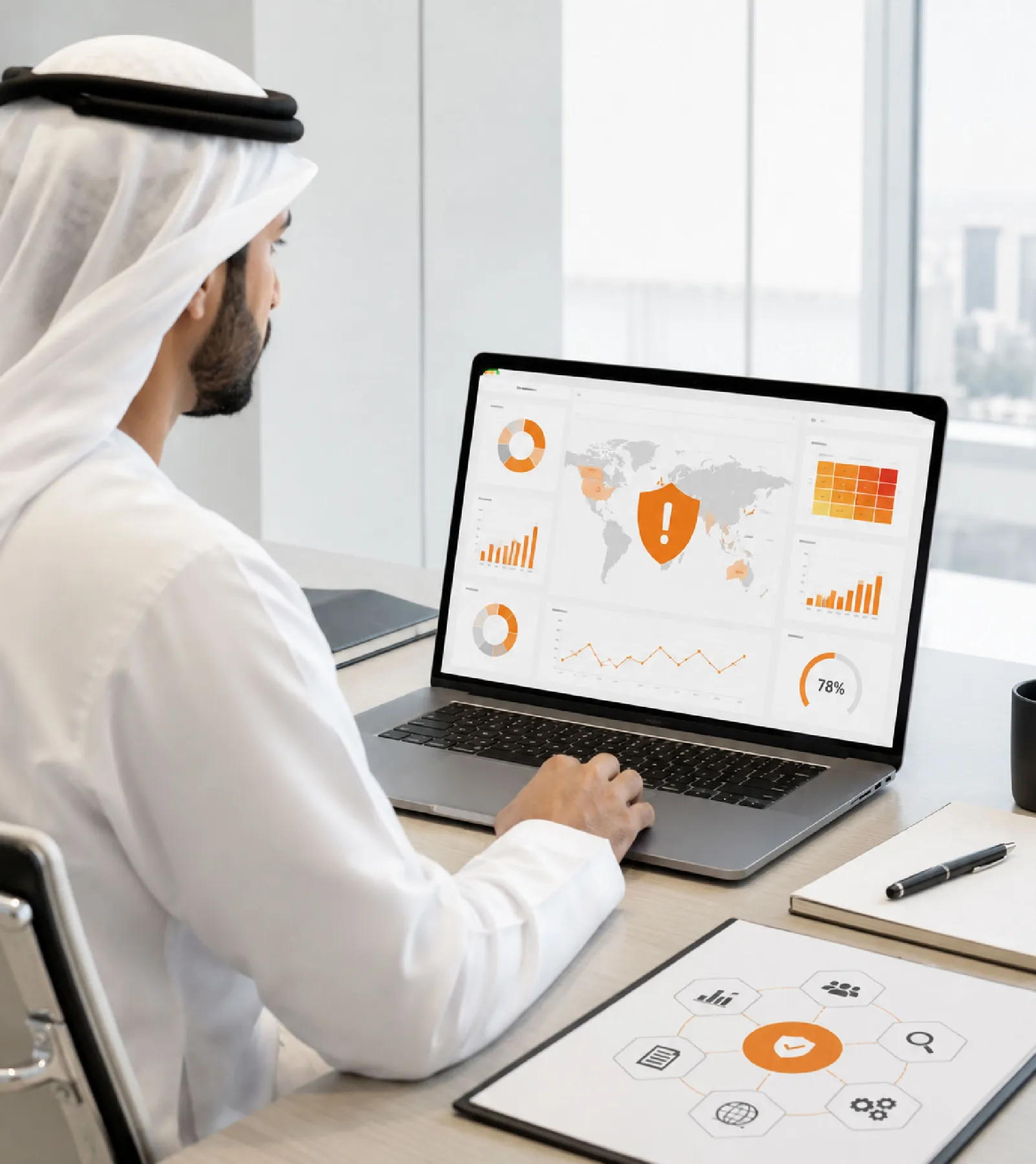
Enterprise Risk Management Software and Consulting Services in UAE

A business can be performing well and still carry risks that management cannot see clearly. Expansion can increase operational exposure, dependence on a few suppliers can threaten continuity, technology failures can interrupt critical processes, and several individually manageable risks can become serious when they occur together.

Enterprise risk management software can improve visibility, but technology alone does not create an effective risk framework. Finsoul Network UAE helps businesses identify which risks matter, how much exposure they are prepared to accept, who owns each risk and what management should see when that exposure changes. This is the foundation of effective enterprise risk management.

What Risks Matter Most to Your Business?

An enterprise risk assessment should focus on events that could materially affect business objectives. The risk universe will differ between organisations because strategy, operating model, industry and dependence on people, technology and third parties are different.

Strategic and Business Risks

Expansion decisions, investments, changing customer demand, new competitors or unsuccessful strategic initiatives can prevent the organisation from achieving planned objectives.

Operational and Technology Risks

Failures involving people, processes, systems, cyber security, suppliers or outsourced providers can interrupt operations or reduce the organisation’s ability to deliver important services.

Financial Risks

Liquidity, credit, market movements, concentrations and other financial exposures can affect cash flow, profitability and resilience. Where deeper analysis is required, these risks should move into a dedicated financial-risk workstream.

Legal, Regulatory and Reputational Risks

Legal obligations, regulatory developments and events affecting stakeholder confidence can create wider business consequences. ERM captures their enterprise impact without replacing specialist legal or compliance work.

Build One View of Risk Across the Organisation

When finance maintains one risk list, operations another and compliance a third, senior management can struggle to see how the exposures connect. ERM brings material risks into a common framework so they can be assessed and discussed against the organisation’s objectives.

Finsoul Network UAE provides enterprise risk management consulting that helps businesses move from separate departmental risk lists to an enterprise view. This is also consistent with established UAE ERM practice: KPMG’s UAE approach emphasises enterprise assessment, current-state maturity, accountability and ongoing risk monitoring rather than treating ERM as a one-time register exercise.

Assess Risk Before Deciding What Needs Attention

Risk assessment creates a consistent basis for comparing exposures. The methodology should be understandable enough for risk owners to use while still giving management meaningful information.

Set Risk Appetite and Know When Exposure Is Too High

Risk appetite turns broad statements about being “low risk” or “careful” into boundaries management can use. It should reflect strategy and distinguish risks the organisation is prepared to accept from exposures requiring additional control.

Risk appetite is a recognised element of mature UAE risk frameworks. For CBUAE-regulated insurance companies, for example, the current ERM standards explicitly connect risk appetite, risk limits, business plans and stress scenarios.

Risk Appetite

This sets the overall amount or type of risk the organisation is prepared to accept while pursuing its objectives. It should be linked to strategy rather than written as an isolated governance statement.

Risk Tolerance

Tolerance gives management a more practical boundary around acceptable variation. It helps determine when changing exposure requires attention.

Risk Limits

Limits can translate appetite into measurable thresholds for particular risks. A breach should trigger a defined response rather than simply appearing in the next report.

Give Every Material Risk a Clear Owner

A risk register cannot manage anything by itself. Material risks need accountable people who understand the exposure, maintain relevant controls and know when the issue must move to senior management.

Turn the Risk Register Into an Action Tool

A useful register tells management more than the name and rating of a risk. It should show what creates the exposure, what protects the business and what still needs to happen.

Use KRIs to See Risk Moving Before It Becomes a Problem

A risk rating tells management where exposure stands at a point in time. A Key Risk Indicator can provide earlier evidence that the exposure is changing. Useful KRIs might track supplier dependence, staff turnover, system incidents, overdue actions, liquidity pressure or other factors directly connected to a material risk.

The indicator should lead to action. Finsoul Network UAE helps organisations establish thresholds and escalation points so KRIs do not become another dashboard of numbers with no clear management response.

What Management and the Board Need to See

Risk reporting should make decisions easier. Senior management usually needs changes, exceptions and significant exposures, not every detail recorded by every department.

  • Highest or most material enterprise risks
  • Risks moving outside approved appetite or tolerance
  • Significant changes since the previous review
  • KRI trends and breached thresholds
  • Overdue or ineffective mitigation actions
  • Emerging risks not yet fully reflected in historical data
  • Important interdependencies between risks
  • Decisions or resources required from management

For UAE organisations subject to specific CBUAE risk rules, governance expectations can be considerably more prescriptive. Current insurance standards, for example, place ultimate responsibility for effective risk management and internal controls with the board and require company-wide visibility of material risks and their interdependencies.

Test What Happens When Several Things Go Wrong

Historical data cannot show every event a business may face. Scenario analysis helps management understand how severe but plausible events could affect objectives and whether existing controls are strong enough.

The UAE regulatory direction increasingly reflects this resilience perspective. CBUAE’s Operational Risk Management Regulation, issued in February 2026 for licensed financial institutions, requires an integrated operational-risk framework and an operational-resilience approach capable of responding to and recovering from disruptive events.

Where Enterprise Risk Management Software Fits

Technology becomes useful once the organisation knows what it needs to manage. Depending on maturity and scale, enterprise risk management software may centralise risk registers, controls, KRIs, treatment actions, incidents, approvals and management reporting.

Finsoul Network UAE approaches enterprise risk management and compliance technology from the framework outward. We define the required methodology, ownership, workflows and reporting before deciding what should be configured or automated. This avoids spending money on a system that merely digitises an ineffective spreadsheet process.

When ERM Is Not Working Properly

Weak ERM is usually visible in management behaviour before it becomes visible in the framework documents.

  • Risks are discussed only before an audit or board meeting.
  • Different departments rate similar risks using different methods.
  • Risk owners cannot explain why an exposure has its current rating.
  • Treatment actions remain overdue without escalation.
  • New projects proceed without considering how they change the risk profile.
  • Risk appetite exists on paper but does not influence decisions.
  • Management receives long risk registers without clear priorities.
  • Enterprise risk management software is being used, but the underlying risk data is unreliable.

Building ERM Into the Business

Effective enterprise risk management consulting services should leave the organisation with a repeatable management process rather than a report that becomes outdated after the engagement ends.

Establish the Current Position

We review objectives, existing risk practices, governance, registers, reporting and how different functions currently identify and manage risk.

Identify and Assess Material Risks

Risk workshops, available data and management input are used to build an enterprise view and prioritise material exposures.

Set Governance and Risk Boundaries

Risk ownership, assessment criteria, appetite, tolerance, limits and escalation arrangements are developed according to the organisation’s needs.

Build the Management Tools

Finsoul Network UAE develops the appropriate registers, treatment plans, KRIs and reporting structure and defines enterprise risk management software requirements where technology is justified.

Embed Review and Reporting

Risk owners and management need a recurring review cycle so changes in strategy, operations and external conditions are reflected in the risk profile.

A phased implementation is also consistent with established market practice. KPMG UAE describes ERM implementation around current-state assessment, enterprise risk assessment and a roadmap adapted to organisational maturity, culture and timeline.

Why Organisations Use Finsoul Network UAE for ERM

The objective is not to create the largest possible risk register. It is to give management a clearer view of uncertainty around the decisions and objectives that matter.

Risk Starts With Business Objectives

Our enterprise risk management services connect risks to strategy and operations instead of beginning with a generic catalogue of possible events.

Ownership Stays With the Business

Risk management works when business leaders and risk owners understand their responsibilities. Finsoul Network UAE builds the framework around accountability rather than shifting every risk to a central risk function.

Reporting Is Built for Decisions

Ratings, KRIs and treatment actions are structured to show management where exposure is changing and where intervention is required.

Technology Supports the Framework

Where software is appropriate, our enterprise risk management consulting services define what the system needs to support before technology becomes the centre of the programme.

Build an Enterprise Risk Management Framework That Management Can Use

ERM should help management see important risks earlier, understand how they connect and decide when action is required.

Talk to Finsoul Network UAE about enterprise risk management software and consulting support for your organisation.

Frequently Asked Questions

Should every department maintain its own risk register?

Departments can maintain more detailed risk information, but material exposures should feed into a consistent enterprise framework. Otherwise, management may receive fragmented ratings and duplicate risks without a reliable organisation-wide view.

Can internal audit own the ERM framework?

Internal audit can provide independent assurance over risk management, but assigning it operational ownership of risks can create independence concerns. Risk ownership normally remains with management and the relevant business functions.

Should new projects be assessed through ERM before approval?

Material projects, investments and major changes can alter the organisation’s risk profile and should be assessed proportionately. CBUAE insurance standards, for example, explicitly require risk review for new activities, products and major strategic matters.

Does a smaller business need the same ERM framework as a large regulated company?

No. Risk management should be proportionate to size, complexity and exposure. Even CBUAE’s insurance standards recognise proportionality in how smaller regulated companies demonstrate compliance with ERM objectives.

How is ERM different from business continuity planning?

ERM covers the wider set of strategic, operational, financial and other material risks affecting objectives. Business continuity and operational resilience focus more specifically on maintaining or recovering important operations when disruption occurs.