A business can have accurate financial records and well-designed operating procedures, yet still face significant control risk if the systems producing that information cannot be relied on. Excessive user access, undocumented system changes, failed interfaces or unreliable automated reports can affect financial reporting, operations and regulatory compliance without being immediately visible to management.

Finsoul Network UAE provides IT assurance services to independently assess the technology controls supporting important business processes and information. Our work focuses on whether access, changes, automated controls, data flows and technology-dependent processes are appropriately controlled and supported by evidence.

When Does Your Business Need IT Assurance?

Technology assurance becomes particularly relevant when business decisions, financial reporting or critical operations depend heavily on systems and automated processes.

ICON FILE
A New ERP or Critical System Has Been Implemented

A major implementation can change access rights, workflows, automated approvals, interfaces and reporting logic. Independent review can identify control weaknesses before they become embedded in normal operations.

ICON FILE
Financial Reporting Depends on System Controls

Where financial information is generated, processed or approved through technology, auditors and management may need confidence that relevant IT controls support reliable reporting.

Data Moves Between Multiple Systems

Where information passes between ERP, CRM, payroll or other connected applications, IT assurance can help identify interface failures, incomplete transfers, duplicate records or uncontrolled manual adjustments that may affect data reliability. 

ICON FILE
Important Processes Are Highly Automated

Automated calculations and approvals reduce manual effort, but a poorly configured control can process large volumes of transactions incorrectly before the problem is detected.

ICON FILE
Access Has Become Difficult to Control

Rapid growth, staff movements and multiple systems can create excessive privileges, dormant accounts or conflicting access rights.

ICON FILE
Technology Has Been Outsourced

Cloud platforms and external service providers can introduce dependencies that require stronger oversight, access management and evidence of third-party controls.

IT General Controls That Support Reliable Systems

IT General Controls, commonly referred to as ITGCs, provide the control foundation supporting systems, applications and technology-dependent processes.

Rather than treating IT as one broad control area, our IT assurance work identifies which technology controls actually matter to the systems and information within scope.

User access management

Who can enter the system and what can each user do?

Privileged access

Who has administrator-level authority capable of bypassing normal restrictions?

Change management

How are system, configuration and application changes requested, tested and approved?

IT operations

Are important scheduled processes, incidents and technology activities appropriately controlled?

Backup and recovery

Can important systems and information be restored when required?

Interface controls

Is information transferred completely and accurately between connected systems?

User Access Should Match Business Responsibility

Access risk is not limited to whether an employee has a valid username. The more important question is whether that employee has the right level of access for their actual responsibilities.

Finsoul Network UAE can review:

  • New-user approval
  • Role-based access
  • Privileged accounts
  • Segregation of duties
  • Transferred employees
  • Terminated-user removal
  • Periodic access reviews
  • Generic and shared accounts
  • Emergency access
  • Access-review evidence

For regulated financial institutions, access governance can also intersect with regulatory technology expectations. Applicable CBUAE, DFSA or FSRA requirements therefore need to be considered according to the entity and technology environment rather than applied universally to every UAE company.

What Happens When System Changes Are Poorly Controlled?

A system can be working correctly today and become unreliable after an uncontrolled configuration, application or database change.

Changes Should Be Authorised

Material changes should have a defined business or technical requirement and appropriate approval before implementation.

Testing Should Happen Before Production

Testing helps determine whether the change performs as intended and whether it creates unintended consequences elsewhere.

Development and Production Should Be Separated

Where practical, individuals developing or modifying systems should not have unrestricted ability to move their own changes directly into the live environment.

Emergency Changes Still Need Control

Urgency may change the normal approval sequence, but emergency changes should remain documented and subject to retrospective review.

This area is particularly important where IT assurance supports financial statement audit or another engagement that relies on system-generated information.

Can You Rely on Automated Controls and System Reports?

Businesses increasingly rely on systems to perform controls that employees previously completed manually. This can improve consistency, but it also changes the nature of control risk.

An automated control may operate thousands of times without human intervention. If its configuration is wrong, the error can therefore be systematic rather than isolated.

Data Integrity Between Systems

Modern businesses rarely operate from one application. Customer information may originate in one platform, transactions in another and financial reporting in an ERP.

Each transfer creates a point where information can be lost, duplicated, altered or classified incorrectly.

Our review can examine whether:

  • Source and destination totals reconcile
  • Rejected transactions are identified
  • Duplicate records are prevented or detected
  • Interface failures generate alerts
  • Manual uploads are controlled
  • Mapping rules are documented
  • Changes to interfaces are tested
  • Material exceptions are investigated

This is one area where IT quality assurance services can provide meaningful control confidence when the phrase is being used in an IT-controls context rather than software product testing.

ERP and System Implementation Assurance

A new ERP can change more than the accounting software. It can alter approval authorities, segregation of duties, reporting logic and the evidence available for key business controls.

An assurance review can be performed at different points in the implementation lifecycle.

Cloud and Third-Party Technology Need Separate Oversight

Moving a system to a cloud or managed-service provider does not remove management’s need to understand technology risk.

The business should know which controls remain its responsibility, which controls are performed by the provider and how assurance over those provider controls is obtained.

Important areas can include:

  • Provider access
  • Customer administrative access
  • Data location and handling
  • Incident escalation
  • Service availability
  • Backup responsibilities
  • Subcontractors
  • Business continuity
  • Termination and data-return arrangements

For regulated businesses, outsourcing and third-party technology may also fall within specific supervisory requirements. The exact obligations depend on the regulator and entity.

Common IT Control Weaknesses We Find

Technology weaknesses often develop gradually as systems, users and business requirements change.

From an IT Control Weakness to Remediation

Finding a technology-control problem is only the first step. The remediation should address the underlying exposure and then demonstrate that the improved control operates.

Understand the Root Cause

The weakness may arise from system configuration, unclear responsibility, poor procedure design or inadequate monitoring.

Assess the Business Impact

We consider what information, process or system could be affected if the weakness continues.

Agree the Corrective Action

Management defines an action appropriate to the risk rather than automatically adding another manual control.

Retest the Improved Control

Where included in scope, remediation evidence can be reviewed to determine whether the agreed change has actually addressed the original finding.

This approach keeps IT assurance connected to risk reduction rather than producing a technical findings list with no clear business outcome.

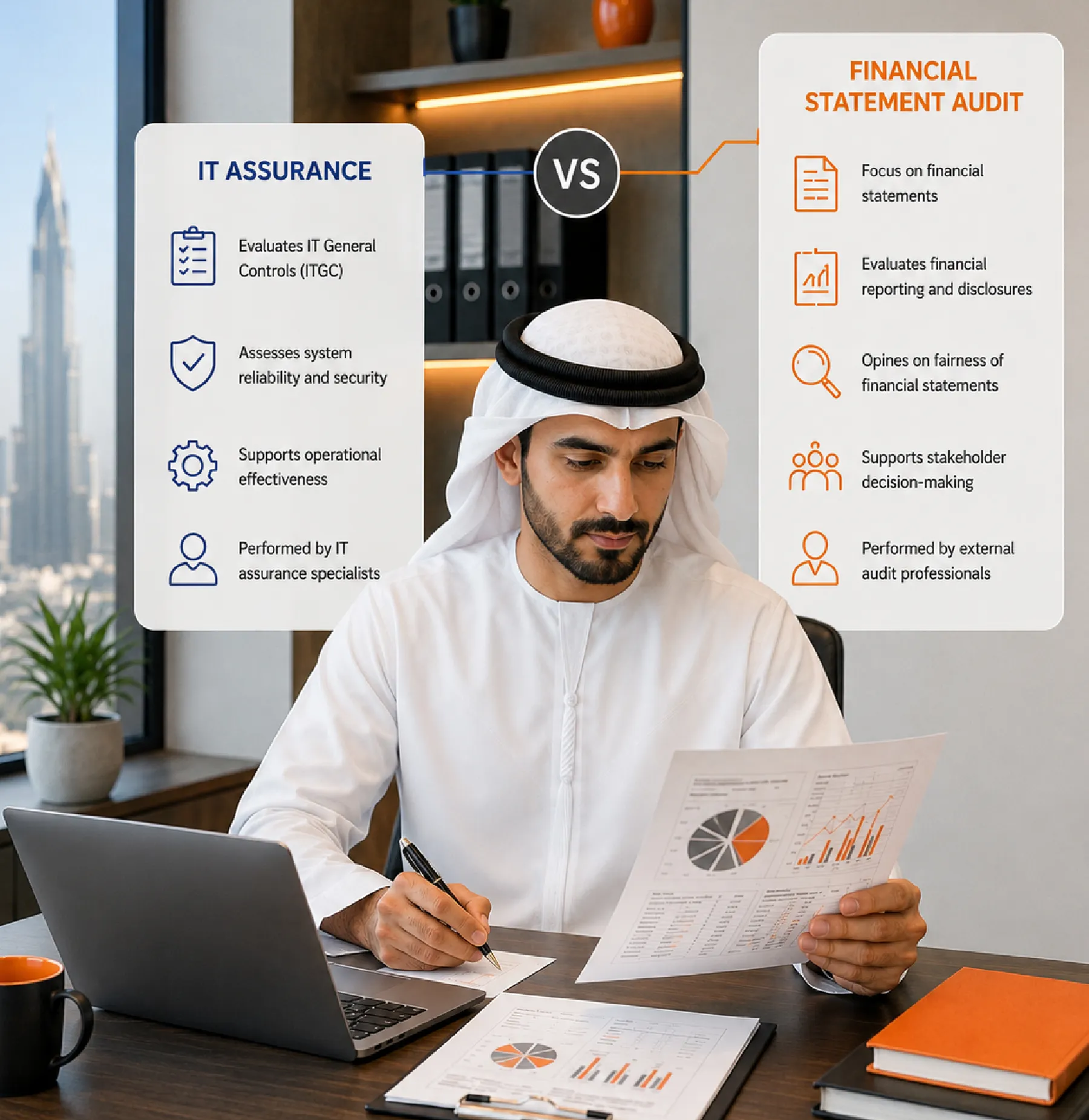
IT Assurance and Financial Statement Audit Are Not the Same

An external financial statement audit may test technology controls where those controls are relevant to financial reporting. That does not mean every technology risk within the organisation is automatically covered by the financial audit.

A dedicated IT assurance engagement can examine systems, controls or technology risks in greater depth when management requires assurance beyond the financial statement audit scope.

Similarly, detailed cybersecurity penetration testing, vulnerability assessment and software quality testing are separate specialist disciplines and should not be represented as ordinary IT-controls assurance.

UAE Regulatory Expectations for Technology Controls

Technology governance has become increasingly important across the UAE’s regulated financial environment. CBUAE standards and regulations contain requirements relating to areas such as operational resilience, information security, outsourcing and technology risk for entities within their respective scope.

DIFC firms can also fall under DFSA technology and cyber-risk expectations according to their regulatory status, while ADGM firms operate under applicable FSRA requirements.

Finsoul Network UAE therefore establishes the entity, regulator and technology environment before incorporating regulatory criteria into an IT assurance engagement. A requirement applying to a CBUAE-regulated institution is not automatically presented as an obligation for an ordinary commercial company.

What You Receive After an IT Assurance Review

The reporting output should make technology findings understandable to the people responsible for business risk, not only to the IT team.

Depending on scope, deliverables can include:

  • IT control assessment
  • Identified control exceptions
  • Risk-rated findings
  • Supporting evidence
  • Management recommendations
  • Agreed remediation actions
  • Responsible action owners
  • Retesting results where applicable

The final output distinguishes control weaknesses from improvement opportunities so management can prioritise material issues.

What Determines IT Assurance Fees and Timing?

The number of systems alone does not determine the engagement effort. One highly integrated ERP can require more detailed work than several simple applications.

Important scope drivers include the number of systems, user population, privileged accounts, complexity of interfaces, automated controls, outsourced technology, number of locations, evidence availability and whether remediation retesting is required.

Professional fees and timelines are estimates only and depend on the technology environment, systems in scope, control complexity, evidence available and depth of testing required.

The final scope, expected completion timeline and professional fee are confirmed after the systems, assurance objective and relevant technology risks have been reviewed.

Why Finsoul Network UAE for IT Assurance?

Technology assurance should translate technical control weaknesses into risks that management can understand and act on.

We Follow the Systems That Matter

The engagement focuses on technology supporting important financial, operational or regulatory processes rather than reviewing every application equally.

Automated Controls Are Tested as Controls

System automation is not assumed to be reliable simply because it reduces human intervention. Configuration, access and supporting evidence remain important.

Technology Findings Are Connected to Business Risk

A privileged-access weakness is explained through what that access could allow, not simply reported as a technical configuration issue.

Regulatory Criteria Are Applied Carefully

Where regulated requirements apply, Finsoul Network UAE uses the framework relevant to the entity rather than presenting every technology expectation as a universal UAE rule.

Get Independent Confidence in Your Technology Controls

When important reporting, transactions and business processes depend on technology, management needs confidence that the controls behind those systems are working as intended.

Speak with Finsoul Network UAE about IT assurance for critical systems, automated controls, ERP environments and technology-dependent business processes.

Frequently Asked Questions

Is IT assurance the same as cybersecurity testing?

No. They can overlap in selected control areas, but cybersecurity testing may involve specialist activities such as vulnerability assessment or penetration testing. IT controls assurance has a broader focus on whether defined technology controls can be relied on.

Can IT assurance be performed before a new ERP goes live?

Yes. Pre-implementation or pre-go-live assurance can identify weaknesses in access design, migration, interfaces and important controls before the system enters normal operation.

Does moving to the cloud remove the need for internal IT controls?

No. Responsibility is usually shared between the organisation and service provider. The business still needs appropriate controls over its own users, configurations, data and provider oversight.

Can system-generated reports be used without additional testing?

It depends on how the report is used and the assurance required. Where a report supports an important control or conclusion, its source data, parameters and relevant system controls may need validation.

Are IT quality assurance and IT assurance always the same service?

No. Terms such as it quality assurance, quality assurance IT and assurance IT can also be associated with software testing. In this service, they refer only where relevant to assurance over technology controls and information reliability, while software product QA should be separately scoped.