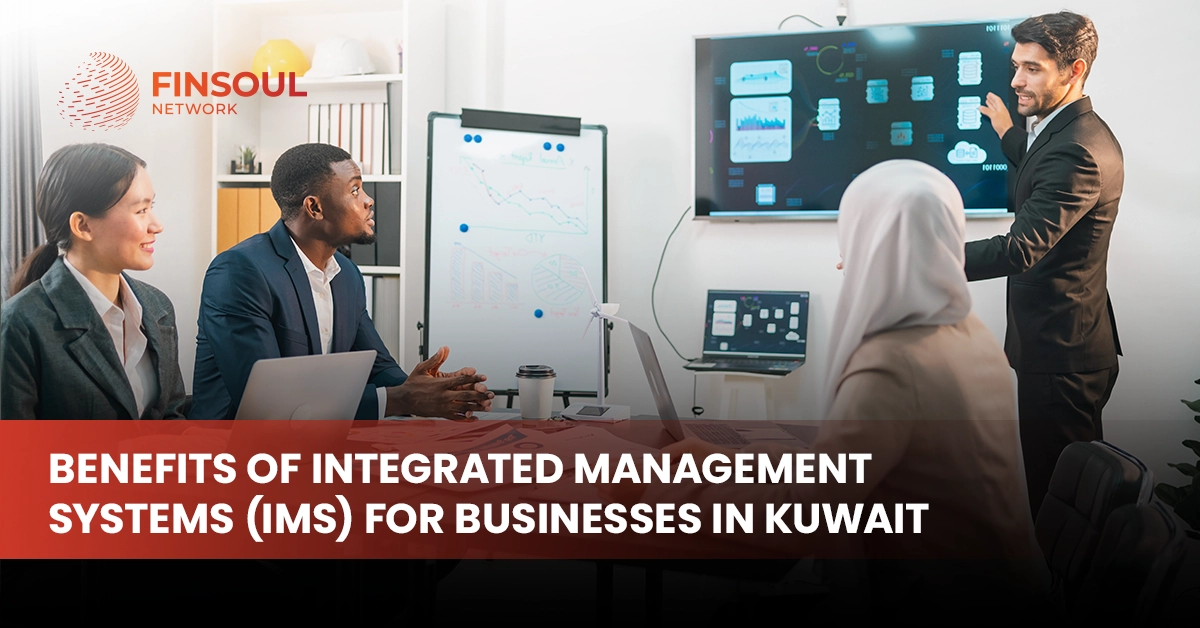
Benefits of Integrated Management Systems (IMS) for Businesses in Kuwait
Running a modern company in Kuwait means juggling quality standards, safety rules, environmental obligations, and project deadlines, often through separate, disconnected processes. That’s exactly the problem an IMS solves. At Finsoul Network Kuwait, we work with organizations across manufacturing, construction, oil and gas services, and facilities operations to help them replace scattered systems with one unified structure. In this guide, we’ll cover what an IMS actually is, why it matters for Kuwaiti businesses in 2026, why more companies are exploring the benefits of System integration, and how the right approach to integration can lower costs while improving performance across the board.
What Is an Integrated Management System?
An integrated management system combines multiple standards, typically ISO 9001 (quality), ISO 14001 (environment), and ISO 45001 (occupational health and safety) into a single, coordinated framework. Instead of maintaining three separate manuals, three sets of audits, and three overlapping teams, a business runs one structure that covers quality, environmental responsibility, and workplace safety together.
This works because the standards share a common backbone, known as the High-Level Structure (Annex SL). Because the clauses on leadership, risk assessment, documentation, and continual improvement are nearly identical across each standard, merging them makes far more practical sense than managing them in isolation. For a growing Kuwaiti business, this shared structure is what turns an IMS from a theoretical idea into something a small compliance team can actually run day to day.
Why Kuwait Businesses Are Turning to Integration
Kuwait’s private sector is under real pressure to modernize. Government tenders increasingly require ISO certification as a prerequisite, international clients expect verifiable compliance, and the country’s broader economic diversification goals push local firms toward international best practice. Against that backdrop, adopting an integrated management system gives companies a single, defensible answer to almost any compliance question, whether it comes from a regulator, an auditor, or an overseas partner.
There’s also a practical, everyday reason companies make the switch. Running separate systems for quality, safety, and environment typically means:
- Multiple audits are scheduled throughout the year, each pulling staff away from core work
- Duplicated documentation that has to be updated in several places at once
- Inconsistent risk registers, since each department tracks hazards differently
- Confused ownership, where nobody is quite sure who’s responsible for what
- Slower onboarding for new staff, who must learn three separate processes instead of one
An integrated approach removes this duplication almost immediately, which is one of the clearest benefits of System integration that Kuwaiti businesses notice within the first year of adopting a unified framework.
Key Benefits of Integration for Kuwaiti Companies
The benefits of integration go well beyond paperwork reduction. Here’s what businesses typically gain once quality, safety, and environmental processes are unified under one management structure:
- Lower certification and audit costs. A single audit cycle covering all standards is far cheaper than running three separate ones.
- Faster decision-making. Leadership reviews one set of performance data instead of reconciling conflicting reports from different departments.
- Stronger risk management. Quality defects, environmental hazards, and safety incidents get assessed together, closing blind spots that siloed systems tend to miss.
- Improved staff engagement. Employees follow one clear process instead of memorizing three overlapping ones.
- Better tender competitiveness. Many Kuwaiti government and private-sector contracts favor bidders holding recognized, unified certifications.
- Easier expansion. A well-built framework can absorb new standards later, in energy management or information security, for example, without starting from scratch.
Taken together, these advantages explain why building this kind of unified framework has become a strategic priority rather than a compliance checkbox for ambitious Kuwaiti companies.
- Simpler regulatory reporting. One consolidated record makes it far easier to respond to Kuwait Municipality, KEPA, or Ministry of Interior civil defense requests.
- Better supplier and contractor accountability. Vendors can be measured against the same quality, safety, and environmental criteria the business holds itself to.
The Role of Integrated Management System Software in Digital Transformation
Paper-based processes don’t scale well once quality, safety, and environmental data all live inside one framework. This is where integrated management system software comes in. Cloud-based platforms now let Kuwaiti businesses manage documentation, corrective actions, audit schedules, and KPIs from a single dashboard, accessible to every department in real time.
A capable platform of this kind typically includes:
- Centralized document control with automatic version tracking
- Real-time dashboards for tracking incidents, non-conformities, and audit status
- Automated reminders for renewals, inspections, and staff training
- Reporting tools that make management review meetings faster and more data-driven
For companies operating across multiple sites in Kuwait, a construction firm with several active project locations, for instance, this kind of software eliminates the need for site managers to manually cross-check paper records, reducing both human error and the time spent preparing for external audits.
Asset Integrity Management: A Core Pillar of IMS
For industries like oil and gas, petrochemicals, and heavy manufacturing, asset integrity management is one of the most valuable components an IMS can support. It focuses on making sure physical assets, such as pipelines, pressure vessels, machinery, and storage tanks, continue to operate safely and reliably throughout their working life.
When these practices are built into a company’s broader IMS rather than handled as a standalone function, inspection schedules, maintenance records, and safety data all flow into the same reporting structure used for quality and environmental compliance. This matters because a failing piece of equipment isn’t just flagged as a maintenance issue under this model; it’s automatically linked to the relevant safety and environmental risk assessments, giving leadership a far more complete picture before a small problem becomes a costly one. Well-run integrity oversight also tends to lower insurance costs, since fewer unplanned failures translate directly into a stronger safety record, and it gives operations teams a documented history to draw on during regulatory inspections.
Integrated Facilities Management and IMS
Integrated facilities management is another area where an IMS delivers clear value, particularly for businesses running large commercial or industrial premises across Kuwait City, Al Ahmadi, or the Shuwaikh industrial zones. Rather than treating cleaning, security, HVAC maintenance, energy use, and health and safety as separate contracts with separate lines of responsibility, this approach brings them under one coordinated plan.
When facility operations are aligned with a company’s overall IMS, facility-level data energy consumption, safety incidents, equipment servicing feeds directly into the organization’s broader performance metrics. That alignment helps property and operations managers spot patterns, such as rising energy costs or recurring maintenance issues, far earlier than they would with fragmented, contract-by-contract oversight. It’s a practical example of how bringing facility operations into the wider system strengthens, rather than complicates, a company’s day-to-day performance.
Project Integration Management Within an IMS Framework
For companies that deliver work through defined projects, construction, engineering, and IT rollouts, project integration management is the discipline of coordinating scope, schedule, budget, resources, and stakeholders into one coherent plan. It’s a core concept from project management best practice, and it fits naturally inside a broader IMS.
When project coordination is connected to the company’s IMS, project managers don’t have to build safety, quality, and environmental checks from scratch for every new job. Instead, they draw on the same standardized procedures, risk assessments, and documentation templates already embedded in the organization’s wider system.
This consistency is especially valuable for Kuwaiti contractors managing multiple concurrent projects, where standardized processes shorten onboarding time for new project teams and reduce the chance of compliance gaps between sites. Applying this discipline consistently also gives senior leadership a clearer, single view of how every active project is performing against quality, safety, and budget targets, a level of visibility that’s difficult to achieve when projects are tracked in isolated spreadsheets.
Steps to Implement an Integrated Management System in Kuwait
Building an effective IMS generally follows six stages:
- Gap analysis reviewing current quality, safety, and environmental practices against the relevant ISO standards.
- Interviewing department heads to understand existing informal processes
- Reviewing past incident and non-conformity records
- Leadership alignment, securing management commitment, and defining clear ownership of the system.
- Process mapping identifies where quality, safety, and environmental procedures overlap and can be merged.
- Documentation and software setup consolidating manuals and, where useful, deploying software to manage records centrally.
- Staff training makes sure every team understands the unified process, not just their previous department-specific version.
- Internal audit and certification testing of the system internally before pursuing formal ISO certification.
Each stage benefits from experienced guidance, since rushing the process often leaves a business with a system that looks integrated on paper but still operates as three disconnected processes in practice. Businesses that invest properly in this groundwork tend to see the benefits of System integration compound year after year, rather than fading once the initial certificate is issued.
Why Choose Finsoul Network Kuwait
We work with businesses across the country to design and implement practical, audit-ready integrated management system frameworks customized to local regulatory requirements and industry realities. Our team supports every stage from initial gap analysis through documentation, staff training, and certification readiness so your system becomes a genuine operational advantage rather than another compliance burden.
Whether you need support with equipment and asset oversight, integrated facilities management, or aligning project integration management with your existing quality and safety processes, we bring the local market knowledge and technical depth to get it right the first time.
Conclusion
An integrated management system is no longer a nice-to-have for Kuwaiti businesses; it’s fast becoming a competitive necessity. By merging quality, safety, and environmental management into one coordinated framework, companies cut costs, reduce audit fatigue, and build a more resilient operation overall.
Add in reliable digital IMS tools, disciplined asset and facility oversight, and strong project coordination, and the result is a business that’s genuinely built to scale, ready to compete for larger contracts and international partnerships with confidence. Finsoul Network Kuwait is ready to help you get there, with hands-on support at every stage of the journey from the first gap analysis to full certification and beyond.
Office Address: [Oula Tower, Omar Ben Al Khattab St, Block 3, Al Mirqab, Kuwait City, Kuwait]
Email: [info@finsoulnetwork.com]
Phone: [+44 7494 154004]
Frequently Asked Questions
What standards are usually combined in an integrated management system?
Most Kuwaiti businesses combine ISO 9001, ISO 14001, and ISO 45001. Additional standards, such as ISO 27001 or ISO 50001, can be added later as the business grows.
How long does it take to implement an IMS in Kuwait?
Implementation typically takes three to six months, depending on company size, current process maturity, and how many sites need to be aligned.
Is integrated management system software necessary for smaller businesses?
It’s not mandatory, but even small businesses benefit from cloud-based tools, since they reduce manual record-keeping and make audits significantly faster.
How does asset integrity management fit into a company that isn’t in oil and gas?
Any business with critical equipment manufacturing lines, HVAC systems, or generators benefits from structured asset integrity practices to prevent costly failures.
Can an integrated management system be customized for different industries in Kuwait?
Yes. An integrated management system can be customized for industries such as construction, manufacturing, oil and gas, and facilities management, while still following the same core ISO framework.
Table of Contents
Book An Appointment
No Comments
Recent Blogs