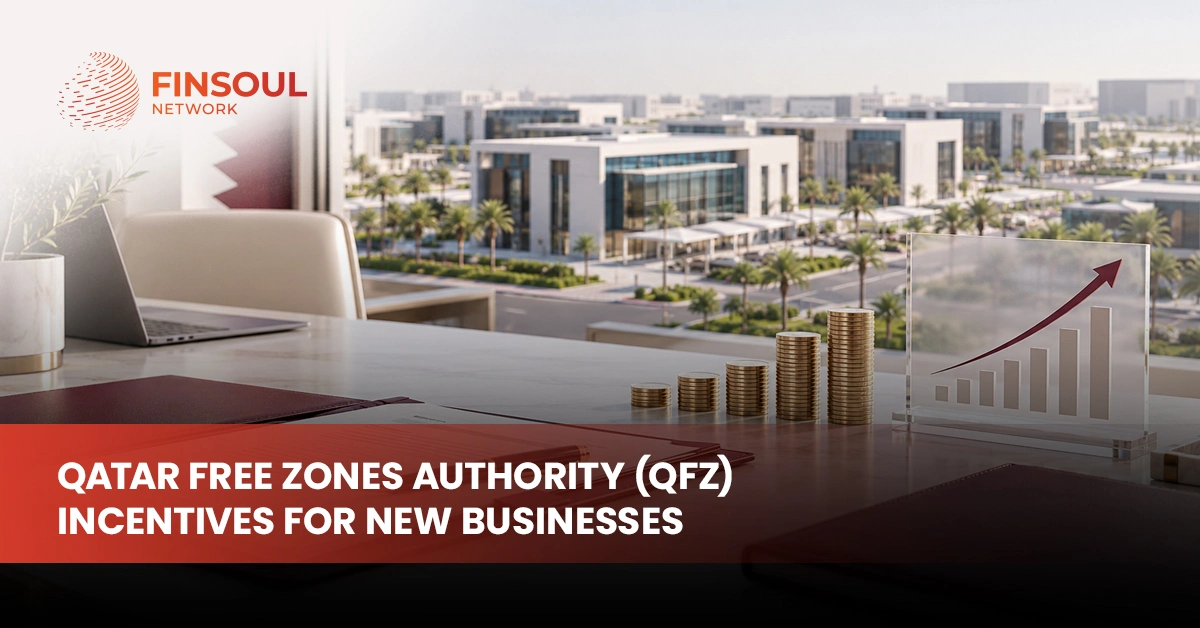

Qatar Free Zones Authority (QFZ) Incentives for New Businesses
Qatar has positioned itself as one of the most ambitious economies in the Gulf, working steadily to become a global investment hub that attracts capital, talent and innovation from across the world. Free zones have become a central part of this strategy, offering international businesses a gateway into the region with fewer restrictions and stronger operational freedoms than many traditional markets provide.
The Qatar Free Zones Authority, commonly referred to as QFZ, sits at the heart of this effort. Established to regulate and develop Qatar’s free zone ecosystem, QFZ has created an environment customised to the needs of foreign investors, with full ownership rights and streamlined registration processes. Finsoul Network Qatar walks through everything a business owner needs to know, from the fundamentals of QFZ to a full breakdown of incentives, eligible industries, application steps and the documentation required to get started.
What is the Qatar Free Zones Authority (QFZ)?
QFZ is the government body responsible for overseeing Qatar’s free zones, providing the regulatory framework, infrastructure and investor support that allow international companies to establish a presence in the country with minimal friction. It was created as part of Qatar’s broader push to diversify its economy away from hydrocarbons and build sustainable, knowledge-based industries capable of competing globally. As the regulatory authority for Qatar’s free zones, QFZ handles everything from licensing to compliance, giving investors a single point of contact throughout the setup process.
QFZ’s work directly supports Qatar National Vision 2030, the state’s long-term plan to build a diversified, sustainable economy underpinned by human development, social progress and environmental stewardship. Two zones fall under its management: Ras Bufontas Free Zone and Umm Al Houl Free Zone, both strategically positioned near Hamad International Airport and Hamad Port, respectively. Each zone has been developed with particular industries in mind, allowing businesses to select a location that aligns closely with their operational needs, whether that means air freight access for technology and logistics firms or port access for manufacturing and maritime industries.
Why Qatar is Becoming a Preferred Business Destination
Qatar’s appeal to international investors goes beyond its free zone incentives and reflects a broader set of structural advantages. The country combines a strategic geographic position with political stability and a government that has consistently prioritised foreign investment as a pillar of economic growth.
- Strategic geographic location gives businesses direct access to Gulf, Middle Eastern, African and Asian markets from a single base.
- Political and economic stability provides the predictability investors need when committing capital to long-term projects.
- Strong government support ensures policies remain consistently oriented toward attracting and retaining foreign businesses.
- Modern infrastructure across transport, logistics and digital connectivity reduces operational friction for new entrants.
- Access to regional and international markets is reinforced by Qatar’s air and sea connectivity through Hamad International Airport and Hamad Port.
- A skilled multinational workforce gives companies the talent base needed to scale operations quickly.
Key QFZ Incentives for New Businesses
QFZ has built its incentive package around the priorities that matter most to foreign investors: ownership control, cost efficiency and operational speed. Each incentive works alongside the others to reduce the barriers typically associated with international expansion.
100% Foreign Ownership
Foreign investors enjoy complete control of their Qatar entity without requiring a local sponsor. This clean ownership structure simplifies governance, strengthens investor confidence, and makes fundraising easier by avoiding complex shareholder arrangements.
Corporate Tax Incentives
Businesses benefit from renewable tax holidays, with zero corporate tax during approved incentive periods. Individuals also enjoy no personal income tax, creating a highly attractive fiscal environment for startups, SMEs, and multinational corporations.
Customs Duty Benefits
Eligible imports are exempt from customs duties, while streamlined clearance procedures reduce delays. Manufacturers and logistics companies gain significant cost advantages, improving supply chain efficiency and enhancing Qatar’s competitiveness as a regional trade hub.
Profit and Capital Repatriation
Companies can freely transfer profits, dividends, and capital abroad without foreign exchange restrictions. This flexibility ensures liquidity, supports global expansion strategies, and reassures investors about the ease of moving funds across international markets.
World-Class Infrastructure
QFZ offers ready-to-use warehouses, offices, and industrial units supported by smart infrastructure. High-speed internet, reliable utilities, and sustainable development standards provide businesses with modern facilities designed for efficiency, scalability, and long-term growth.
One-Stop Business Setup
Company incorporation, licensing, immigration support, customs registration, and regulatory approvals are streamlined under one authority. This integrated approach reduces administrative burdens, accelerates market entry, and ensures smoother compliance for new investors.
Flexible Real Estate Solutions
Businesses can choose from office spaces, industrial land, warehouses, or built-to-suit facilities. These scalable options allow companies to expand operations seamlessly as demand grows, ensuring long-term adaptability and cost efficiency.
Fast Business Registration
Digital documentation, online applications, and investor portals enable rapid company setup. This efficient process minimises delays, reduces paperwork, and allows businesses to begin operations quickly in Qatar’s competitive free zone environment.
Access to Skilled Workforce
Simplified employment procedures, visa facilitation, and streamlined sponsorship make hiring global talent easier. Businesses gain access to a diverse, skilled workforce, supporting innovation and operational excellence across multiple industries.
Business-Friendly Regulatory Framework
Transparent regulations, investor protection, and efficient dispute resolution mechanisms create a secure business environment. Streamlined compliance processes ensure companies can focus on growth while maintaining confidence in Qatar’s legal and regulatory framework.
Industries that Benefit Most from QFZ Incentives
While QFZ incentives apply broadly, certain industries are particularly well suited to the infrastructure and support available within the free zones. Businesses operating in these sectors often find the combination of tax benefits, logistics access and specialised facilities especially valuable.
- Logistics and supply chain operators benefit from proximity to Hamad Port and streamlined customs processes.
- Manufacturing and advanced manufacturing businesses gain access to industrial land, warehousing and duty-free imports of raw materials and equipment.
- Technology and digital services companies, including those working in artificial intelligence, find an environment built around connectivity and innovation support.
- Data centres and cloud services providers benefit from Qatar’s investment in digital infrastructure and energy reliability.
- Maritime industries are well positioned given the country’s port access and shipping connections.
- Renewable energy firms align closely with Qatar’s economic diversification goals and sustainability commitments.
- Healthcare and medical technology companies benefit from growing government investment in the sector.
- Research and innovation organisations find institutional support that complements Qatar’s wider knowledge economy ambitions.
Additional Competitive Advantages Beyond Financial Incentives
Beyond the direct financial incentives, QFZ offers several structural advantages that strengthen its appeal for long-term investment. These benefits often matter as much to investors as the tax and ownership incentives themselves.
- Excellent connectivity through Hamad Port and proximity to Hamad International Airport supports efficient import, export and passenger travel.
- Gateway access to GCC markets allows businesses based in Qatar to serve neighbouring economies with relative ease.
- A stable legal framework gives investors confidence that contracts and regulatory commitments will be upheld consistently.
- An established innovation ecosystem supports businesses working in emerging technology and research-driven sectors.
- Government-backed economic diversification ensures continued investment in infrastructure and incentive programmes over the coming years.
Who Can Apply for QFZ Incentives?
QFZ incentives are designed to be accessible to a wide range of business types, from early-stage startups to established multinational corporations. The eligibility criteria focus more on sector alignment and operational suitability than on company size or origin.
- Foreign investors and international corporations looking to establish a regional base in Qatar.
- SMEs and startups seeking a cost-effective entry point into the Gulf market.
- Technology companies and industrial manufacturers whose operations align with QFZ’s target sectors.
- Logistics operators and regional headquarters are aiming to use Qatar as a hub for wider Gulf and international operations.
Eligibility Requirements for QFZ Businesses
Meeting QFZ’s eligibility requirements involves demonstrating that a proposed business is both viable and aligned with the free zone’s strategic sectors. Investors should expect a review process that considers the nature of the business alongside its supporting documentation.
- Eligible business activities must fall within sectors supported by QFZ’s development strategy.
- Investment suitability and sector alignment are assessed to ensure the business complements existing free zone industries.
- Required documentation typically includes company records, ownership details and financial information.
- Business plan expectations require a clear outline of operations, growth strategy and market approach.
- Compliance requirements and regulatory approvals must be satisfied before registration can be finalised.
How to Apply for QFZ Incentives
The QFZ application process has been structured to move investors from initial enquiry to operational launch as efficiently as possible. While timelines vary depending on business complexity, the general pathway follows a consistent set of stages.
Step 1: Initial Business Assessment
QFZ reviews the proposed business activity to confirm it aligns with the free zone’s supported sectors and strategic priorities.
Step 2: Choose the Appropriate Free Zone
Investors select between Ras Bufontas and Umm Al Houl based on their industry, logistics needs and proximity requirements.
Step 3: Prepare Required Documentation
Businesses compile the necessary corporate, financial and personal documents ahead of formal submission.
Step 4: Submit Online Application
The application is lodged through QFZ’s investor portal, supported by digital documentation submission.
Step 5: Business Review and Approvals
QFZ carries out its assessment process, reviewing eligibility, compliance and sector fit before granting approval.
Step 6: Company Registration
Once approved, the business proceeds to formal registration and licensing under QFZ’s regulatory framework.
Step 7: Lease or Facility Allocation
Businesses secure office space, warehousing or industrial land suited to their operational requirements.
Step 8: Operational Launch
With registration and facilities in place, the business begins operations within the free zone.
QFZ vs Mainland Qatar: Which is Better?
The right choice between QFZ and mainland Qatar depends largely on a business’s ownership preferences, target market and operational model. Free zone companies typically offer greater ownership freedom, while mainland entities allow broader access to the domestic Qatari market.
- Foreign ownership is generally 100% within QFZ, compared with more restrictive requirements historically associated with mainland structures.
- Corporate tax treatment in QFZ can include incentive-period exemptions, while mainland businesses follow standard national tax rules.
- Customs duties are typically reduced or removed for QFZ businesses on eligible imports.
- Office requirements in QFZ often come with ready-built facilities, while mainland setups may require independent premises sourcing.
- Business activities permitted in QFZ are generally sector-specific, whereas mainland companies can typically operate across a wider range of activities.
- Import and export advantages favour QFZ businesses due to port and airport proximity and customs benefits.
- Regulatory authority for QFZ businesses sits with QFZ itself, while mainland companies fall under Qatar’s general commercial regulatory bodies.
- Ideal business types for QFZ include manufacturing, logistics and technology firms, while mainland setups often suit businesses targeting local consumer markets directly.
Common Mistakes Investors Should Avoid
Even with a supportive regulatory environment, businesses can run into avoidable setbacks during the setup process. Being aware of common pitfalls in advance helps investors plan a smoother path to registration and operation.
- Choosing the wrong free zone without properly assessing logistics, industry fit or long-term growth needs.
- Selecting incorrect business activities that fall outside QFZ’s supported sectors.
- Underestimating compliance requirements tied to licensing and ongoing regulatory obligations.
- Ignoring licensing conditions that apply specifically to certain business activities.
- Submitting incomplete documentation, which can delay approval and registration timelines.
- Poor expansion planning that fails to account for future space, staffing or facility needs.
- Not seeking professional guidance during a process that involves multiple regulatory and legal considerations.
Ready to Establish Your Business in QFZ?
Take advantage of Qatar Free Zones Authority’s unmatched incentives, from 100% foreign ownership to tax holidays and world-class infrastructure. Our team helps you manage registration, compliance, and expansion seamlessly.
Contact Us Today
Email: info@finsoulnetwork.com
Conclusion
QFZ offers one of the most compelling incentive packages available to foreign investors entering the Gulf region, combining full ownership rights, tax advantages, customs benefits and world-class infrastructure within a single regulatory framework. For startups and international investors alike, the appeal lies not only in the financial incentives but in the operational simplicity and long-term stability that QFZ provides.
Establishing operations within Qatar’s free zones offers genuine long-term value for businesses looking to build a lasting presence in the region. Companies considering expansion should evaluate QFZ carefully against their industry, growth plans and regional ambitions, taking into account which zone, regulatory pathway and business structure best supports their objectives moving forward.
Frequently Asked Questions
Can foreigners own 100% of a QFZ company?
Yes. QFZ allows full foreign ownership without requiring a local sponsor or partner. This clean structure gives investors complete operational control, simplifies governance, and enhances fundraising opportunities by avoiding complex shareholder arrangements.
Are QFZ companies exempt from corporate tax?
Many QFZ businesses benefit from renewable tax holiday incentives, with zero corporate tax during approved periods. Eligibility depends on the specific incentive package granted, while individuals enjoy no personal income tax in Qatar.
How long does company registration take?
Timelines vary depending on business complexity and sector approvals. However, QFZ’s digital application system and investor portal are designed to keep registration efficient, often enabling setup within weeks rather than months.
Can QFZ companies trade within mainland Qatar?
Trading arrangements depend on licensing terms. While QFZ entities enjoy international market access, businesses should confirm specific permissions for mainland Qatar during the application process to avoid compliance issues.
Which industries qualify for incentives?
Logistics, manufacturing, technology, maritime, and renewable energy are among the sectors best supported by QFZ. Each industry benefits from customised infrastructure, regulatory frameworks, and incentive packages aligned with Qatar’s diversification goals.
Table of Contents
Book An Appointment
No Comments